
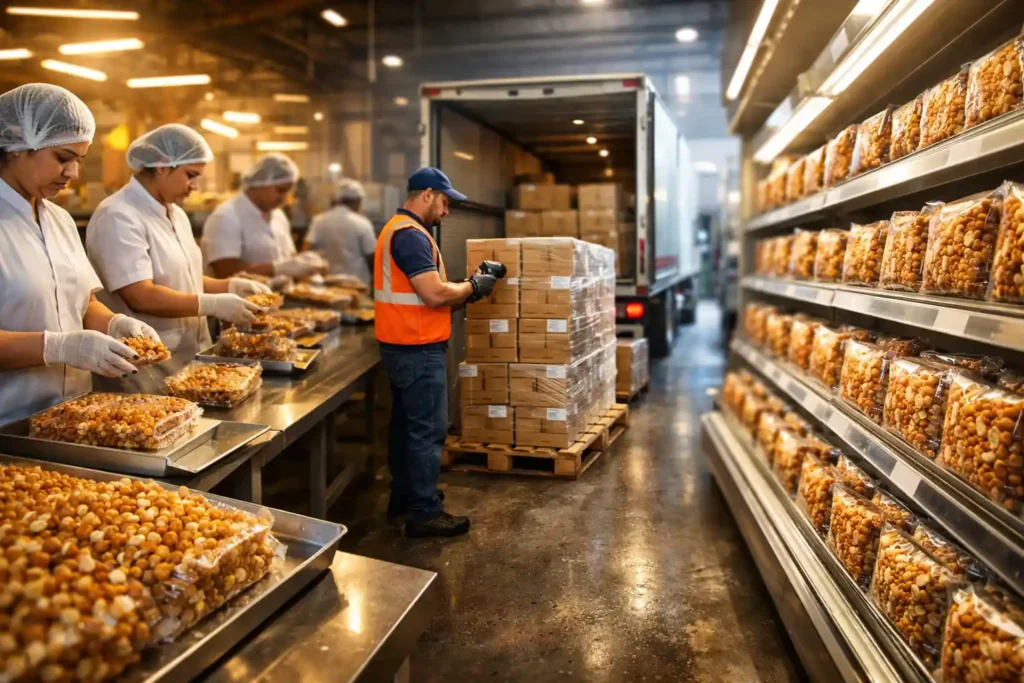
Chikki delivery is the final and most critical extension of manufacturing. While most people focus on ingredients, roasting quality, and packaging design, the reality is this: a well-made product can lose its value if the supply chain is poorly managed.
In traditional foods like chikki – especially jaggery-based variants – stability, handling discipline, and storage conditions directly affect shelf life, texture, and consumer experience. That is why structured delivery systems are not optional; they are part of responsible manufacturing.
As India’s food processing sector continues to expand – projected to reach over US$ 535 billion by 2025–26 according to India Brand Equity Foundation – distribution networks are becoming more organized, competitive, and performance-driven.
Source: https://www.ibef.org/industry/food-processing-india
At the same time, India’s processed food exports (HS 16–22) crossed US$ 8 billion in FY 2023–24, reflecting long-term demand for packaged food products across global markets.
Source: https://indusfood.co.in/article/indias-fb-exports-in-2023-24/
These numbers show one clear trend: traditional snacks are no longer limited to local markets. They move across states, distribution hubs, modern retail chains, and sometimes international borders. Delivery discipline now determines scalability.
From Manufacturing Floor to Market: Understanding the Full Chain
The chikki supply chain does not begin at dispatch. It begins inside the factory.
The complete structured flow typically follows:
Raw Material → Production → Packaging → Dispatch → Transport → Warehouse → Retail Shelf
If you want to understand how production discipline supports this flow, we have explained it in detail in our pillar guide on how chikki manufacturing process works, where we break down batch control, roasting balance, jaggery temperature handling, and quality checks step by step.
Delivery is the continuation of that manufacturing responsibility.
Factory Dispatch: Where Delivery Actually Begins
Dispatch is not a simple loading activity. It is a controlled process designed to protect traceability and accountability.
Before any cartons leave the unit, several checkpoints are verified:
- Batch code accuracy
- Manufacturing and best-before dates
- Carton sealing integrity
- Invoice documentation
- GST compliance
- Transport documentation
A responsible chikki manufacturer ensures that every dispatched batch can be traced back to production records. This traceability becomes essential in case of distributor queries, retail audits, or quality clarifications.
Without structured dispatch systems, large-scale supply becomes unstable.
The Science Behind Chikki Delivery Stability
Chikki, especially jaggery-based varieties, is sensitive to environmental conditions. It may appear dry and shelf-stable, but moisture absorption and heat exposure can affect texture and binding.
During transport, risks include:
- Humidity during monsoon seasons
- Long highway heat exposure
- Improper stacking pressure
- Rough handling during loading and unloading
Proper transport conditions for chikki delivery typically include:
- Ambient transport (no refrigeration required)
- Dry, sealed vehicle interiors
- Controlled stacking height
- Moisture-resistant secondary packaging
According to FSSAI guidance on traditional sweets, moisture control and proper storage play a major role in preserving shelf stability, especially for jaggery-based products. This reinforces the link between packaging design and delivery systems.
Shelf Life vs Supply Chain Timeline
A product may have a printed shelf life of 6 to 12 months. However, real-world availability depends on how efficiently it moves through the supply chain.
Consider a typical domestic distribution cycle:
- 2–3 days: Production and quality hold
- 1–4 days: Transit to distributor
- 7–14 days: Warehouse rotation
- 60–120 days: Retail shelf movement
This means delivery efficiency directly impacts how much shelf life remains when the product reaches consumers.
Poor dispatch planning reduces effective selling time.
Structured Distribution Models in India
India’s snack supply chains operate under multiple distribution structures:
- Direct factory-to-distributor dispatch
- Super-stockist and regional redistribution
- Modern retail warehouse supply
- E-commerce fulfillment center delivery
In chikki wholesale operations, delivery planning becomes batch-oriented rather than unit-oriented. Larger volume orders require synchronized production schedules and dispatch slots.
Consistency in supply strengthens distributor confidence and builds repeat ordering cycles.
Packaging Integrity & Transit Protection
For brittle products like chikki, breakage during transit is a major operational challenge.
Even if taste and quality are perfect, cracked pieces reduce visual appeal and consumer satisfaction.
To minimize breakage, structured factories use:
- High GSM corrugated cartons
- Proper inner pack sealing
- Palletization and shrink wrapping
- Clear stacking instructions
Packaging is not separate from delivery. It is engineered to support transit stability.
Data-Driven Reality: Why Delivery Discipline Is Becoming Critical
India’s organized retail sector continues to expand, and private label snack brands are increasing shelf presence in supermarkets and online platforms.
As supply chains become more structured:
- Retailers demand consistent dispatch schedules
- Distributors expect predictable lead times
- Buyers require documentation and traceability
- Exporters demand compliance and pallet standards
This environment rewards manufacturers who integrate production and delivery systems seamlessly.
Export Supply Chain Considerations
When chikki moves beyond domestic markets, additional steps apply:
- HS code documentation
- Export invoices
- Freight forwarder coordination
- Container loading supervision
- Customs clearance documentation
Processed food exports from India operate under strict documentation and classification systems. Stability during long sea voyages also requires moisture protection and pallet discipline.
Export success depends as much on delivery control as on production quality.
Risk Management in Chikki Delivery
Even strong manufacturing systems can face delivery risks. Common challenges include:
- Transit delays
- Excess humidity exposure
- Improper warehouse stacking
- Retail storage mismanagement
Mitigation requires:
- Clear storage guidelines for distributors
- Carton labeling with handling instructions
- Structured pallet height limits
- Moisture-resistant packaging
Supply chain resilience builds long-term trust.
Delivery Completes the Manufacturing Responsibility
Manufacturing and delivery are not separate departments. They are connected stages of one responsibility chain.
If production is disciplined but delivery is careless, shelf quality suffers.
If delivery is disciplined but production is inconsistent, brand credibility suffers.
That is why structured manufacturing systems integrate:
- Batch coding
- Shelf-life validation
- Packaging engineering
- Dispatch documentation
- Delivery planning
A reliable supply chain strengthens both retailer trust and consumer confidence.
Final Perspective
Chikki delivery is not just logistics. It is the final stage of quality control.
From factory dispatch to retail shelf:
- Traceability protects accountability.
- Packaging protects stability.
- Transit discipline protects shelf life.
- Structured planning protects wholesale relationships.
As traditional snacks scale across markets, delivery systems must scale with equal discipline.
When manufacturing expertise connects seamlessly with supply chain control, traditional foods remain consistent, reliable, and competitive in modern retail environments.
Internal References: Explore the Complete Manufacturing Chain
Chikki delivery is only one part of a structured manufacturing ecosystem. To understand the full flow from sourcing to market, you may also explore:
- Chikki manufacturing process – A detailed breakdown of how raw materials move through roasting, mixing, cutting, and quality control inside an organised production unit.
- OEM & private label manufacturing model – Explains how brands collaborate with experienced factories to launch private label products without owning their own production facility.
- Starting a chikki manufacturing unit – Covers investment planning, machinery setup, licensing, and operational challenges for new entrepreneurs entering the industry.
- Food safety rules & regulatory requirements – A practical guide to FSSAI compliance, documentation, hygiene systems, and traceability standards every structured manufacturing unit must follow.
Together, these guides explain how disciplined production, regulatory responsibility, and supply chain management connect to create reliable long-term manufacturing systems.