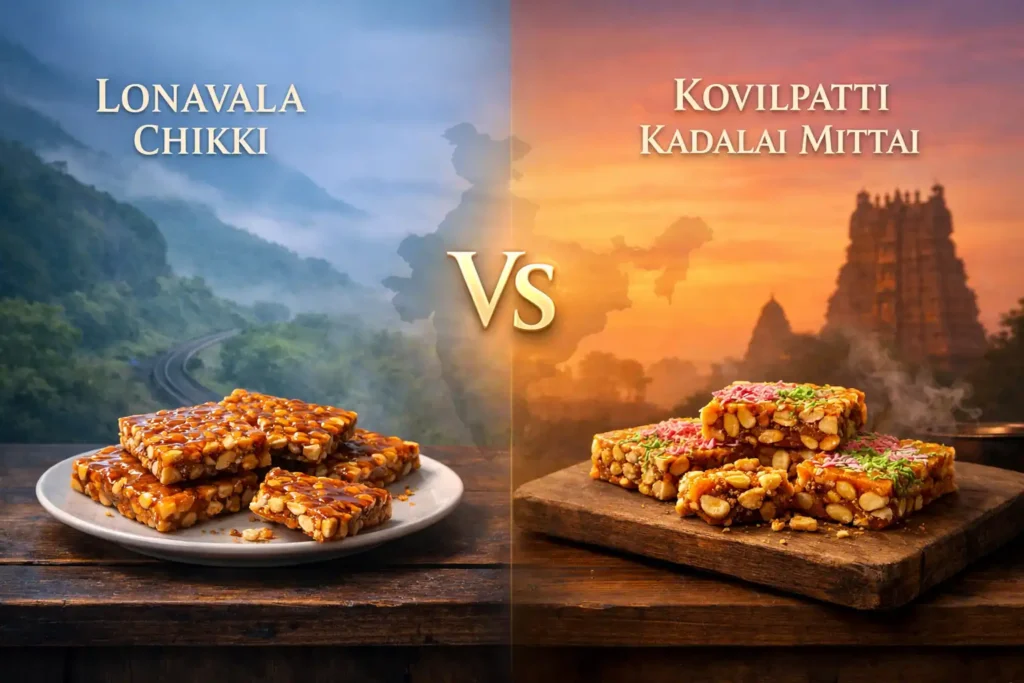
In India’s vast landscape of traditional sweets, two peanut-jaggery confections dominate regional identity debates – Lonavala Chikki (Maharashtra) and Kovilpatti Kadalai Mittai (Tamil Nadu).
At first glance, both look similar: peanuts bound with jaggery, cut into slabs. But when examined through history, trade economics, GI protection, ingredient geography, and manufacturing traditions, they represent two very different food cultures.
This is not a taste comparison. This is a documented, data-backed analysis.
1️⃣ Origin & Historical Timeline: Railway Snack vs Festival Sweet
Lonavala Chikki – Born from the Railways (Late 1880s)
- Origin: Late 1880s (~1888)
- Founder: Bhivrajji (Bhimraj) Agarwal
- Commercialized by: Maganlal Agarwal
- Original Name: “Gud Dani”
- Region: Mumbai–Pune railway construction belt
During British-era railway construction through the Western Ghats, laborers needed a cheap, high-energy, portable food. Bhivrajji Agarwal began selling jaggery mixed with peanuts to workers. His son Maganlal later refined the recipe and secured railway approval for onboard sales.
The word “Chikki” is believed to derive from Marathi chikkat (sticky).
By the 1960s–1980s, Lonavala chikki became a tourism souvenir, especially on the Mumbai–Pune corridor.
Industry Value (2026 estimates):
₹450 Crore annually
15+ major manufacturers
10–15 tonnes daily production
~2,000 direct workers
However, despite its scale, Lonavala Chikki does not yet have a GI tag. An application (No. 948, filed August 2022) is still under examination.
Kovilpatti Kadalai Mittai – Festival Root to GI Recognition (1940s Formalization)
- Origin (modern slab form): 1940s
- Pioneer: Ponnambala Nadar
- Region: Thoothukudi district, Tamil Nadu
- Pre-1940 version: Ball-shaped “urundai” prepared during village festivals
Kovilpatti’s black soil produces oil-rich small peanuts. Manufacturers traditionally used:
- Aruppukottai groundnuts
- Dual jaggery (regular + Theni vellam)
- Water from the Thamirabarani river
- Firewood stove (veragu aduppu)
In April 2020, Kovilpatti Kadalai Mittai received GI Certificate No. 363, officially recognizing its geographic uniqueness.
Industry Impact:
- ~120 manufacturers
- 40,000 kg daily production
- ~15,000 workers (direct + indirect)
- Estimated turnover ₹100+ Crore
Unlike Lonavala’s railway expansion, Kovilpatti spread through bus routes and temple town trade networks.
This regional evolution has already been explored in your History of Kadalai Mittai, but here we’re examining its national positioning.
👉 For more detailed information about Kovilpatti Kadalai Mittai and its complete cultural background, you can refer to our Kovilpatti Kadalai Mittai story blog.
👉 To understand the deeper traditional roots and how kadalai mittai evolved across Tamil Nadu, you can also explore our detailed coverage on the History of Kadalai Mittai.
2️⃣ Ingredient Geography: Soil, Water & Sweetener Science
| Factor | Lonavala Chikki | Kovilpatti Kadalai Mittai |
|---|---|---|
| Peanut Source | Maharashtra | Aruppukottai & black-soil towns |
| Sweetener | Jaggery + sugar/liquid glucose (modern variants) | Dual jaggery (Theni vellam + regular) |
| Binding | Ghee | Thamirabarani river water |
| Cooking Fuel | Gas / open flame | Firewood mandatory for GI |
| Topping | None | Colored grated coconut |
Key technical difference:
- Lonavala versions often include liquid glucose for gloss and shelf life.
- Kovilpatti GI standards emphasize traditional jaggery and firewood cooking.
Shelf life:
- Lonavala: Several months
- Kovilpatti: ~60 days
This ingredient purity is one reason Kovilpatti is often positioned in traditional snack exports.
3️⃣ Nutritional Breakdown (Per 100g Approximation)
- Calories: 490–520 kcal
- Protein: 14–18g
- Carbohydrates: 40–45g
- Sugars: ~40g
- Iron: ~7% DV
- Magnesium: 27–42 mg
- Zero cholesterol
Health Positioning:
✔ Plant protein rich
✔ Iron from jaggery
✔ Winter energy snack
Concerns:
- High glycemic load
- Karnataka removed chikki from midday meals in 2025 due to sugar/fat concerns
- Storage hygiene issues reported in certain regions
So from a policy perspective, it is both celebrated and regulated.
4️⃣ Economic Comparison: Pricing & Market Spread
Retail Price (2026)
Lonavala Peanut Chikki:
₹480–600 per kg (premium dry fruit versions exceed ₹1,200/kg)
Kovilpatti Kadalai Mittai:
₹260/kg (after 40% hike in Jan 2026)
Groundnut price surged from ₹8,000 to ₹14,000 per 80-kg bag – directly impacting Tamil Nadu manufacturers.
Export Reach:
Lonavala:
Primarily domestic, tourism-focused, online sales
Kovilpatti:
Exports to Singapore, Malaysia, UK, USA, Bahrain, Qatar, Kuwait
The Kadalai Mittai Market in Tamil Nadu has grown strongly post-GI recognition, especially among diaspora buyers.
5️⃣ Legal & Trademark Reality
Lonavala Case:
- “Maganlal” was never trademarked early.
- Hundreds of shops use the name.
- Original family earns < ₹10 crore of ₹450 crore industry.
- 2018 FDA action temporarily halted production over compliance issues.
Kovilpatti Case:
- GI granted 2020.
- Fake GI labels reported outside region.
- Association monitoring misuse.
This shows two different paths:
- Brand-first, protection-later (Lonavala)
- Protection-first formal recognition (Kovilpatti)
6️⃣ Cultural Identity
Lonavala
- Linked to Mumbai–Pune travel culture
- Monsoon tourism souvenir
- Makar Sankranti til chikki tradition
- Diwali gifting category
Kovilpatti
- Pongal association
- Temple town purchase tradition
- Village festival roots
- Seen as a protein snack, not just sweet
In Tamil Nadu, kadalai mittai is often positioned closer to everyday food than luxury gifting.
7️⃣ Production Model Difference
Lonavala:
- Semi-industrial scaling
- Gas stoves allowed
- Larger retail storefront model
Kovilpatti:
- Firewood-based production
- Family enterprise clusters
- MSME-driven ecosystem
This structure directly connects to modern kadalai mittai wholesale networks and regional distribution hubs.
If you study a traditional kadalai mittai company model in Kovilpatti, you’ll notice raw material sourcing is often hyper-local and season-dependent.
8️⃣ Output & Scale Comparison
| Metric | Lonavala | Kovilpatti |
|---|---|---|
| Daily Production | 10–15 tonnes | 40 tonnes |
| Workers | ~2,000 | ~15,000 |
| Manufacturers | 15+ major | 120+ |
| GI Tag | Pending | Granted (2020) |
Kovilpatti currently surpasses Lonavala in daily production volume.
9️⃣ Popular Variants
Lonavala:
- Peanut
- Til
- Cashew
- Chocolate
- Rajgira
- Puffed rice
- Fruit-flavored variants
Kovilpatti:
- Slab
- Ball (urundai)
- Coconut-topped
- Loose uthiri format
- Mini bite packs
The variation scale is wider in Maharashtra, but identity protection is stronger in Tamil Nadu.
🔟 The Core Difference in One Line
Lonavala Chikki grew through railway tourism and branding.
Kovilpatti Kadalai Mittai grew through soil, water, firewood — and later legal protection.
Final Perspective
Both are peanut-jaggery sweets.
But one is a ₹450 crore tourism-driven industry still fighting trademark confusion.
The other is a 120-manufacturer GI-recognized cluster supporting 15,000 livelihoods with 40 tonnes daily output.
And when discussing the evolution of Peanut Chikki in India, this regional divergence becomes one of the most interesting case studies in traditional food economics.