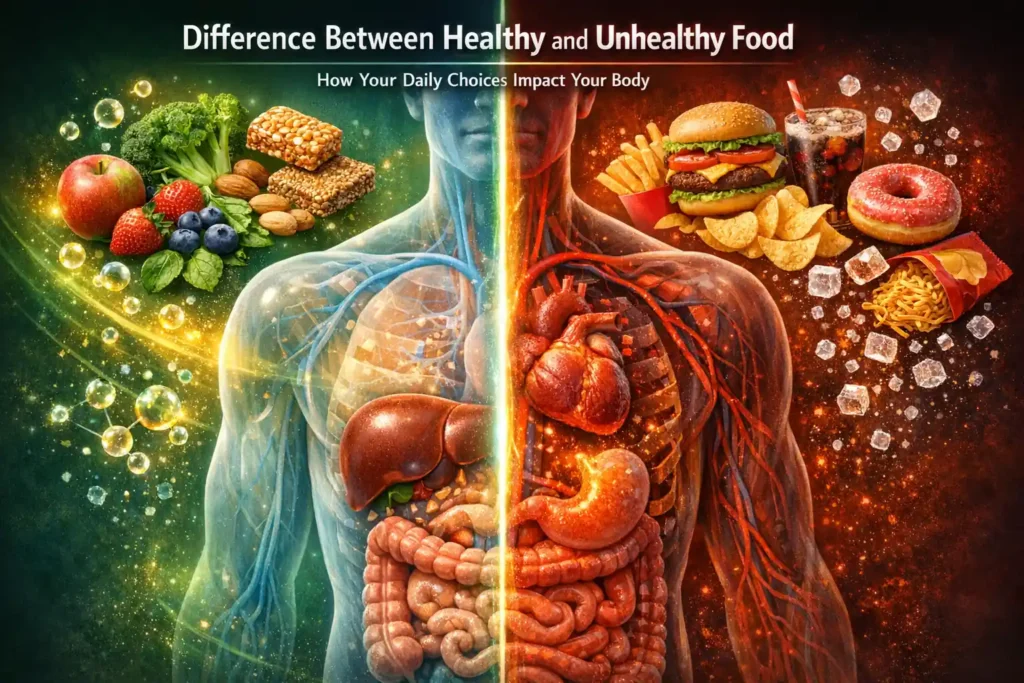
We all know the answer when someone asks us to choose between healthy food and junk food. We know which one is better. Yet supermarkets, food delivery apps, and fast-food outlets are growing faster than ever. So what is really happening?
This blog explores the difference between healthy food and unhealthy food, what are healthy food and unhealthy food in practical terms, the scientific reasons behind cravings, the marketing psychology that shapes our choices, and why traditional nutrient-rich foods are often ignored in modern times.
What Are Healthy Food and Unhealthy Food?
Before comparing, we need clarity.
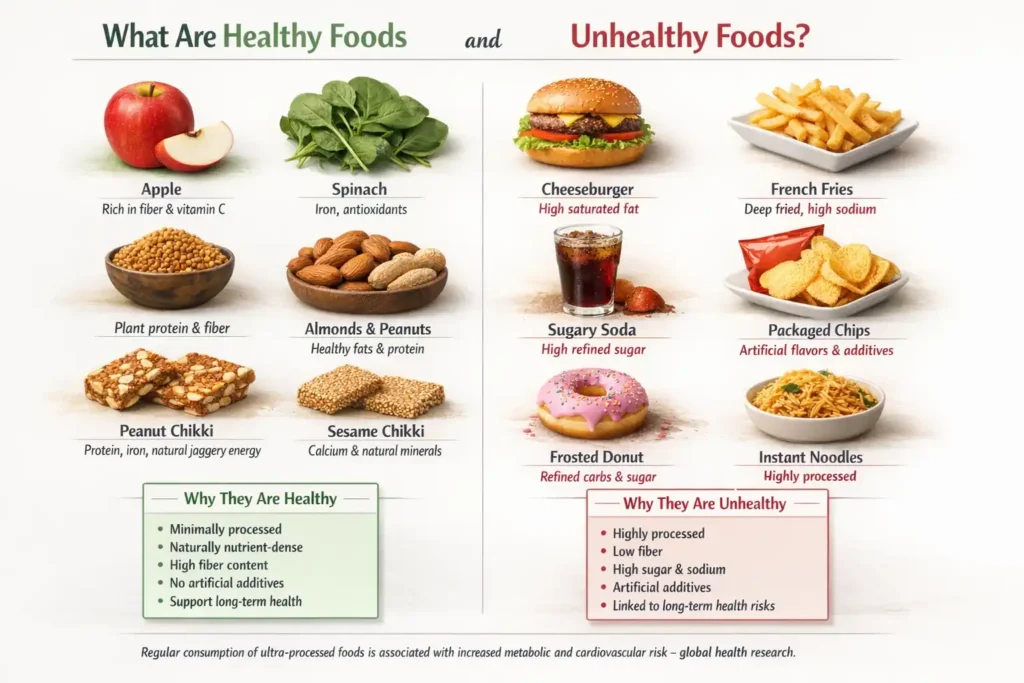
What Are Healthy Foods?
Healthy foods are those that are:
- Minimally processed
- Nutrient-dense
- Naturally rich in fiber
- Free from artificial additives
- Balanced in proteins, healthy fats, and complex carbohydrates
Examples include:
- Fruits and vegetables
- Whole grains
- Lentils and legumes
- Nuts and seeds
- Traditional snacks like peanut chikki (kadalai mittai), sesame chikki (ellu mittai), and similar simple-ingredient sweets
When prepared in hygienic environments such as a regulated chikki factory, healthy foods manufacturer setting, these traditional snacks maintain ingredient transparency and nutritional integrity without unnecessary preservatives.
Healthy food nourishes the body. It supports long-term function rather than instant stimulation.
What Are Unhealthy Foods?
Unhealthy foods, commonly called junk foods, are:
- Highly processed
- High in refined sugars
- High in unhealthy fats
- High in sodium
- Low in fiber and micronutrients
- Containing artificial additives
Examples include:
- Sugary soft drinks
- Packaged chips
- Processed desserts
- Instant noodles
- Deep-fried fast food
These foods are engineered for taste intensity and repeat consumption rather than nutritional value.
Difference Between Healthy Food and Unhealthy Food
To simplify the comparison, here is a structured breakdown:
Comparison Chart
| Factor | Healthy Food | Unhealthy Food |
|---|---|---|
| Processing Level | Minimal | Highly Processed |
| Fiber Content | High | Very Low |
| Nutrient Density | High | Low |
| Additives | Rare | Common |
| Energy Release | Slow & Stable | Quick Spike & Crash |
| Long-Term Impact | Protective | Risk Increasing |
This table shows structure. But behavior tells another story.
If unhealthy food is harmful, why do we still choose it?
The Scientific Reasons People Are Easily Attracted to Junk Food
Modern food science explains this clearly.
1. Dopamine Activation
Ultra-processed foods trigger dopamine release in the brain. Dopamine is the “reward chemical” that makes us feel pleasure.
Research from global health institutions including Harvard Health and NIH indicates that sugar and fat combinations stimulate brain reward pathways strongly. The brain remembers that pleasure and pushes us to repeat it.
Healthy food satisfies hunger. Junk food stimulates the brain.
2. Hyper-Palatability Engineering
Junk foods are scientifically designed with:
- Perfect salt-sugar-fat ratios
- Crunch and texture science
- Artificial flavor enhancers
- Fast-melting structures
This combination overrides natural fullness signals.
In contrast, traditional snacks like peanut chikki (kadalai mittai) or sesame chikki provide protein and natural fats that increase satiety instead of encouraging overconsumption.
3. Research Statistics
According to global public health reports:
- Ultra-processed food consumption is strongly linked with obesity and metabolic disorders.
- Higher intake of refined sugar increases risk of type 2 diabetes.
- Diets rich in whole foods are associated with lower cardiovascular risk.
Multiple international studies show people consuming higher amounts of ultra-processed foods tend to consume more calories overall compared to minimally processed diets.
The difference between healthy food and unhealthy food is not opinion. It is measurable in metabolic markers.
Marketing Reasons Behind Junk Food Dominance
Science explains cravings. Marketing explains popularity.
Junk food brands invest heavily in:
- Bright packaging colors that stimulate appetite
- Emotional storytelling advertisements
- Celebrity endorsements
- Child-targeted branding
- Convenience messaging like “instant” or “ready-to-eat”
Healthy foods rarely have that level of promotional force.
Even when produced in a modern chikki factory, healthy foods manufacturer environment with proper hygiene and quality control, traditional snacks depend more on ingredient quality than aggressive advertising.
Marketing shapes perception. Perception shapes demand.
Why Healthy Foods Are Mostly Ignored
The issue is not lack of awareness. It is behavioral patterns.
Common Reasons:
- Instant gratification culture
- Busy urban lifestyles
- Emotional eating habits
- Social influence
- Perception that healthy food is boring
Traditional nutrient-rich foods are sometimes seen as “old-fashioned” despite offering better nutritional profiles than modern processed snacks.
For example:
- A chocolate bar may provide quick sugar stimulation.
- Peanut chikki (kadalai mittai) provides protein, iron, and sustained energy due to peanuts and jaggery.
The body reacts differently to both.
Modern Lifestyle & Food Environment
Today’s environment encourages unhealthy choices through:
- Increased screen-time snacking
- Late-night eating habits
- High stress levels
- Growing food delivery platforms
- Reduced home cooking time
Convenience is often prioritized over nutrition.
Healthy food requires intention. Junk food requires impulse.
Long-Term Health Impact
Consistent unhealthy food consumption may increase risk of:
- Obesity
- Insulin resistance
- Type 2 diabetes
- Cardiovascular disease
- Chronic inflammation
- Gut microbiome imbalance
Healthy food supports:
- Stable blood sugar
- Better digestion
- Improved immunity
- Sustained energy
- Reduced inflammation
The difference between healthy food and unhealthy food is cumulative. It builds slowly over years.
Psychological Insight: Why Knowledge Is Not Enough
Knowing what are healthy food and unhealthy food does not automatically change behavior.
Human decision-making is influenced by:
- Emotional state
- Surrounding environment
- Habit loops
- Social norms
Food choices are rarely logical. They are often emotional.
Small daily improvements create measurable health changes over time.
The Shift Toward Simple, Transparent Foods
Modern consumers are gradually:
- Reading ingredient labels
- Preferring clean-label products
- Avoiding artificial preservatives
- Choosing traditional recipes with fewer ingredients
Traditional snacks produced in hygienic and regulated environments such as a chikki factory, healthy foods manufacturer setup are increasingly valued for simplicity and transparency.
This shift is driven by awareness, not trend.
Practical Steps to Make Better Choices
You do not need extreme dieting.
Start with manageable changes:
- Replace one junk snack per day with nuts or seeds
- Choose traditional simple-ingredient sweets occasionally
- Drink water instead of sugary beverages
- Check labels for added sugars
- Focus on fiber-rich foods
Consistency matters more than perfection.
Final Reflection
The difference between healthy food and unhealthy food goes beyond calories.
It is about:
- Metabolic impact
- Long-term disease risk
- Brain chemistry
- Marketing influence
- Lifestyle habits
Healthy food supports.
Unhealthy food stimulates.
One builds resilience.
One builds dependency.
If you are someone who values simple, traditional snacks prepared with ingredient transparency and hygiene, brands like RudrasFoods traditional chikki manufacturer continue preserving those roots while aligning with modern quality standards.
Food is not just fuel. It is a long-term investment in your health.
Choose consciously.