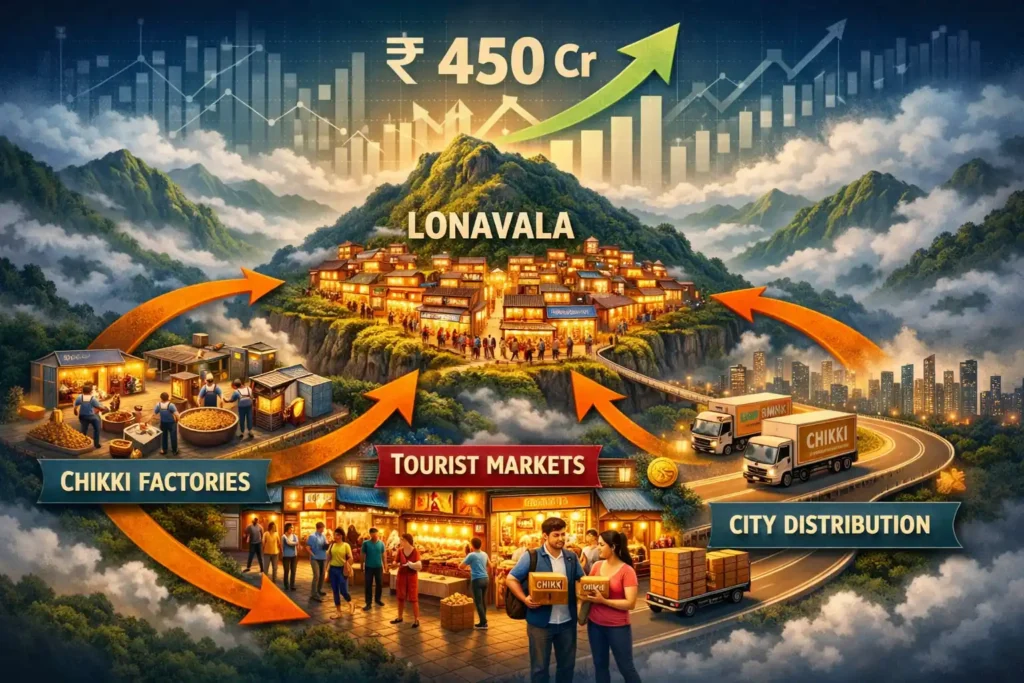
Every weekend thousands of vehicles climb the misty roads of the Western Ghats toward the hill station of Lonavala. While waterfalls, viewpoints, and cool weather attract tourists, there is another reason many travelers stop in the town: buying boxes of the crunchy jaggery-nut sweet that has become synonymous with the region.
Behind these roadside shops lies a surprisingly organized traditional industry. Over more than a century, a simple railway snack evolved into a commercial cluster worth hundreds of crores. Today the lonavala chikki market operates as a combination of tourism economy, small-scale manufacturing hub, and regional snack distribution network.
Understanding how this market works reveals how traditional food products can transform into major economic ecosystems.
A ₹450 Crore Traditional Snack Industry
Recent industry reports estimate that the chikki business centered in Lonavala generates approximately ₹450 crore in annual turnover. The cluster produces 10–15 tonnes of chikki every day, supplying tourists, retailers, and distributors across India.
The industry structure includes:
• around 15 major manufacturers
• dozens of smaller family-run production units
• tourist retail outlets across the town
• wholesalers and interstate traders
Industry overview
| Indicator | Estimated Value |
|---|---|
| Annual turnover | ₹450+ crore |
| Daily production | 10–15 tonnes |
| Major manufacturers | ~15 |
| Direct employment | ~2000 workers |
| Indirect employment | ~1000 workers |
This makes the sweet industry one of the most recognizable economic activities in Lonavala, alongside tourism and hospitality.
The Families and Brands That Built the Industry
The commercial success of the region’s sweet trade is closely tied to a few influential families and companies.
Maganlal Food Products
One of the oldest names associated with the industry traces its origins to 1888, when Bhewrajji Agarwal opened a sweet shop in the town in the name of his son Maganlal Agarwal.
Later generations expanded the business:
• Ambalal Agarwal
• Mohanlal Agarwal
• Pralhad Agarwal
• Bharat Agarwal
Today the company produces several varieties of chikki and related sweets and supplies both domestic and export markets.
According to family interviews, around 70% of their production still consists of whole or crushed groundnut varieties, showing how the original recipe continues to dominate.
National Chikki
Another major brand in the region is National Chikki Mart, which expanded distribution networks and product variety. The company sells:
• groundnut chikki
• sesame chikki
• chocolate chikki
• mixed dry fruit varieties
A large share of its sales reportedly comes from tourists visiting from Mumbai, which highlights how closely the industry depends on travel patterns.
Other well-known manufacturers
Several additional businesses contribute to the competitive ecosystem:
• A-1 Chikki
• Navaratna Chikki
• Rupam Food Makers
• Kalekars Chikki
• Purohit Chikki
• Cooper’s Fudge and Chikki
Many of these shops operate both retail outlets and production units.
The Curious Case of “Too Many Maganlal Shops”
One unusual feature visitors often notice is the large number of shops using the name Maganlal.
Because the brand name was widely copied by other retailers over decades, many shops now operate under variations such as:
• “Original Maganlal”
• “Real Maganlal”
• “Maganlal’s Famous Chikki”
Industry observers have pointed out that although the overall lonavala chikki market generates hundreds of crores annually, only a small fraction of that revenue goes to the original family business.
This situation highlights a broader issue of brand dilution and trademark enforcement within traditional food clusters.
Tourism: The Engine Driving Sales
Unlike most packaged snack industries, this market depends heavily on tourism.
Studies of visitor patterns suggest that 70–90% of sales are linked to travelers, especially those arriving from Mumbai and Pune.
Tourism statistics illustrate the scale of this demand:
| Tourism indicator | Estimated value |
|---|---|
| Weekend tourist flow | ~61,800 visitors |
| Hotels & resorts | 92 properties |
| Total rooms | ~2,400 |
| Annual visitors (Tiger & Lion Point region) | ~1.4 million |
Because of this constant tourist movement, shops near the railway station, main market street, and scenic viewpoints often experience peak sales during weekends and monsoon seasons.
Supply Chain: Where the Ingredients Come From
Although the sweet is strongly associated with Maharashtra, its ingredients come from multiple agricultural regions.
Major ingredient sourcing
| Ingredient | Supply regions |
|---|---|
| Peanuts | Gujarat, Maharashtra |
| Jaggery | Maharashtra, Karnataka |
| Sesame seeds | Rajasthan, Gujarat |
| Dry fruits | Domestic & imported markets |
India is among the world’s largest peanut producers, with Gujarat alone contributing more than 40% of national production. This supply chain ensures consistent availability of raw materials for manufacturers.
These ingredients are also the foundation of many traditional nut brittles, including peanut chikki and regional sweets like kadalai mittai from Tamil Nadu.
Pricing Structure: From Wholesale to Tourist Retail
The industry operates on a layered pricing system.
Typical price ranges
| Product category | Price range |
|---|---|
| Basic groundnut chikki (wholesale) | ₹140–₹150 per kg |
| Retail peanut chikki | ₹250–₹450 per kg |
| Premium dry fruit varieties | ₹700–₹1600 per kg |
Because tourists often buy impulsively and as souvenirs, retail shops can command higher margins compared to wholesale traders.
Manufacturing Capacity and Production Techniques
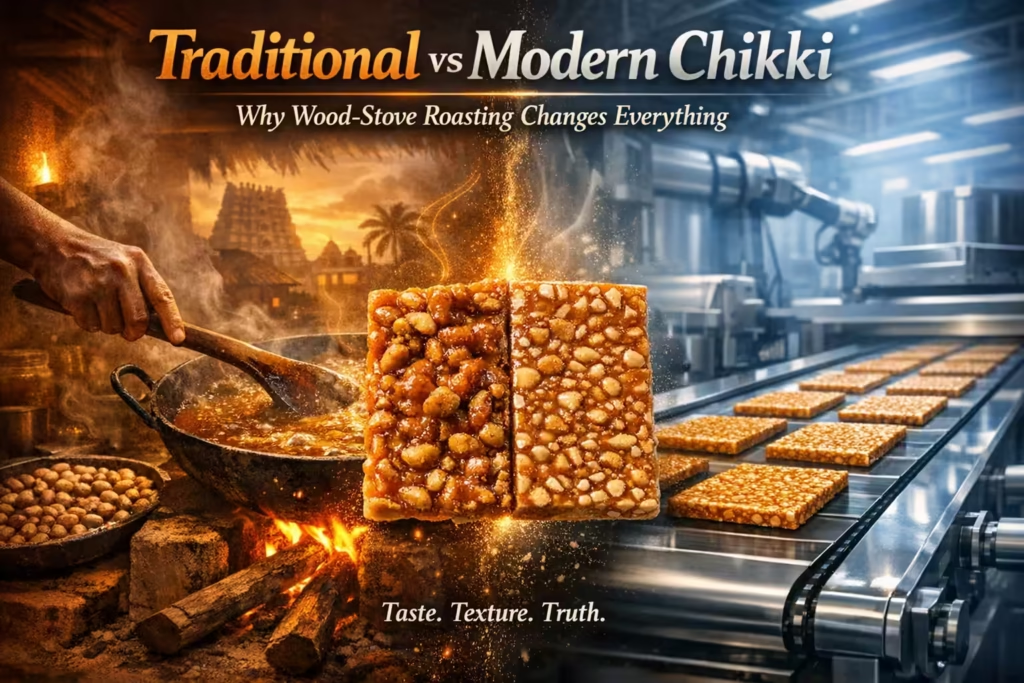
Even though the recipe is traditional, production has gradually become more organized.
Typical production stages include:
- roasting peanuts
- preparing jaggery syrup
- mixing and coating nuts
- flattening into sheets
- cutting into pieces
- cooling and packaging
Some larger manufacturers now use semi-automated machines such as:
• rotary nut roasters
• steam-jacketed boiling pans
• rolling machines
• mechanical cutters
At the cluster level, average production per manufacturer is estimated at 700–1000 kg per day, although some factories can produce significantly more.
Retail Culture: Why Tourists Always Buy It
The sweet has become part of the travel ritual between Mumbai and Pune.
Several factors encourage purchases:
• long shelf life
• easy portability
• affordable gift option
• strong cultural association with the town
Because of this, travelers rarely leave Lonavala without buying at least one box.
Export Markets and Global Demand
While tourism remains the primary sales driver, manufacturers are increasingly exporting products abroad.
Export shipments labeled as chikki or peanut brittle have been recorded in markets such as:
• United States
• United Kingdom
• Canada
• Australia
• UAE
• Qatar
These exports typically move through Nhava Sheva port near Mumbai.
The growth of ethnic grocery stores and online marketplaces has further expanded global demand.
Food Safety and Regulatory Oversight
As the industry has grown, regulatory scrutiny has also increased.
For example:
• In 2018, Maharashtra FDA inspected several manufacturing units.
• Production at Maganlal Food Products was temporarily halted until compliance improvements were made.
• A product sample later showed synthetic colour levels exceeding permitted limits, which could lead to fines up to ₹5 lakh under food safety regulations.
These incidents pushed many manufacturers to improve quality control systems.
Future Opportunities for the Industry
Despite challenges, the industry still has strong growth potential.
Key opportunities include:
• premium gift packaging
• e-commerce distribution
• health-focused nut snacks
• export expansion
Because chikki uses simple ingredients such as nuts and jaggery, it can also be positioned as a traditional alternative to modern energy bars.
Conclusion
The growth of the Lonavala chikki industry shows how a simple traditional sweet can evolve into a thriving regional economy. With dozens of retail shops, around fifteen major production units, and daily output reaching nearly 10–15 tonnes, the town has built a strong reputation as one of India’s most recognizable snack clusters driven by tourism and traditional confectionery skills.
For retailers, distributors, or businesses interested in this heritage product, working with an authentic chikki manufacturer ensures consistent quality, traditional preparation methods, and reliable sourcing from the heart of this historic sweet-making hub.