
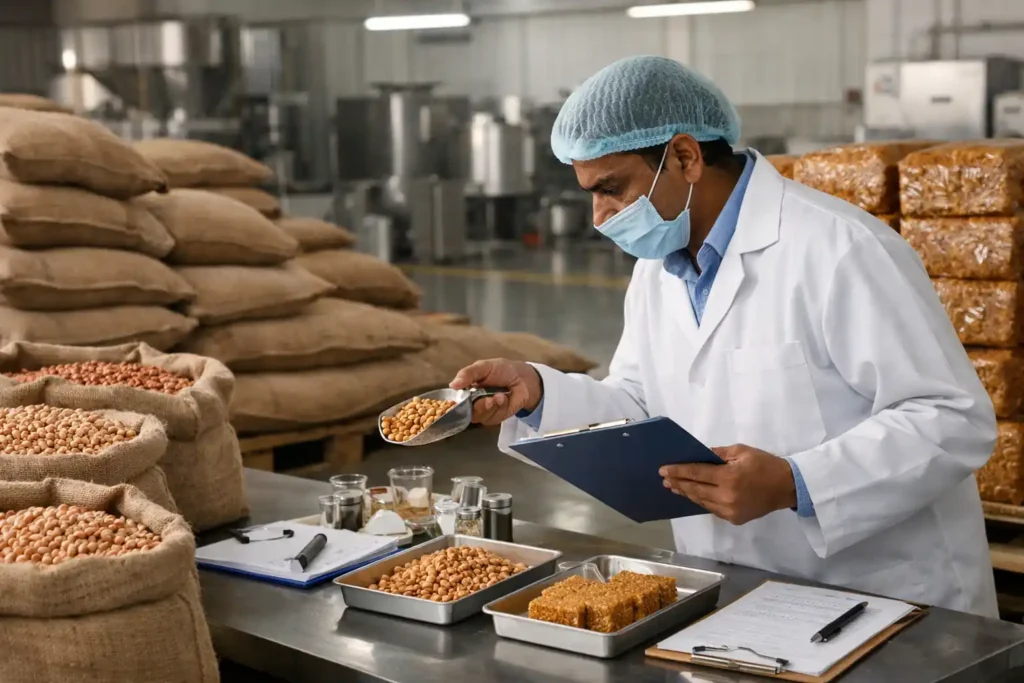
In food manufacturing, most quality discussions begin at the production floor – machines, cooking methods, hygiene, and packing. However, experienced manufacturers know a deeper truth:
Quality is decided much before production begins.
Raw material sourcing is the silent foundation of reliable food manufacturing. Whether the product is traditional or modern, large-scale or small-batch, organised factories place strong emphasis on how raw materials are selected, evaluated, handled, and stored.
This guide explains raw material sourcing in food manufacturing from a 360° factory perspective, covering insights, industry practices, and lessons commonly followed by large and organised manufacturers.
Why Raw Material Sourcing Matters More Than Most People Think
In food manufacturing, raw materials are not just inputs—they determine:
- Taste consistency
- Texture and binding behaviour
- Shelf stability
- Production efficiency
- Complaint rates
Unlike other industries, food manufacturing offers very limited correction opportunities. If raw material quality is weak, no amount of process control can fully fix the outcome.
This is why experienced factories treat raw material sourcing as the first quality control checkpoint.
Understanding Raw Materials in Food Manufacturing
Raw materials in food manufacturing broadly include:
- Primary ingredients (grains, nuts, sweeteners, oils)
- Secondary ingredients (binders, spices, additives where applicable)
- Packaging materials (which affect shelf life and safety)
In traditional food manufacturing, where ingredient lists are minimal, raw material quality becomes even more critical. With fewer ingredients, there is nowhere to hide defects.
What Manufacturers Actually Check in Raw Materials
Contrary to popular belief, factories do not judge raw materials only by appearance or price. Organised manufacturers evaluate how raw materials behave, not just how they look.
Common internal quality parameters include:
- Physical uniformity and grading
- Moisture behaviour during storage
- Performance under heat (roasting, cooking)
- Breakage and yield percentage
- Shelf-life stability after processing
Industry insight:
Large manufacturers often say that a “good-looking” raw material that behaves poorly during processing is more dangerous than a visually average one that performs consistently.
Regional Sourcing Strategy: Why Location Matters
Food manufacturing factories rarely source raw materials randomly. Regional sourcing decisions are based on:
- Climate conditions
- Soil characteristics
- Crop cycles and harvesting patterns
- Scale of cultivation
- Supply chain stability
Certain regions naturally offer better consistency due to large-scale cultivation and predictable supply patterns. This does not automatically mean “higher quality” or “lower quality” – it means better manufacturing control.
For organised factories, sourcing from stable regions helps reduce variability, production disruptions, and unexpected quality deviations.
Supplier Selection: Why Big Manufacturers Think Long-Term
Large and disciplined food manufacturing units prefer fewer, reliable suppliers over frequent switching.
Reasons include:
- Predictable quality behaviour
- Traceability
- Stable communication
- Easier quality enforcement
Short-term price-based buying often leads to long-term instability. That is why organised factories treat suppliers as partners in consistency, not just vendors.
Cost vs Quality: How Manufacturers Calculate the Real Cost
One of the most misunderstood areas in food manufacturing is cost calculation.
Factories do not look only at purchase price per kg. They evaluate:
- Processing loss
- Rejection percentage
- Spoilage risk
- Impact on production speed
- Complaint handling cost
A slightly higher-priced raw material may result in lower overall manufacturing cost due to better yield and stability.
This is why experienced manufacturers think in terms of usable output, not just raw material price.
What Happens When Raw Materials Enter the Factory
Once raw materials arrive at the factory gate, they are not immediately used.
Organised factories follow internal checks such as:
- Visual and physical inspection
- Moisture assessment
- Batch segregation
- Storage suitability review
Raw materials may be rejected or downgraded even after procurement if they fail internal standards. This discipline is a key difference between organised manufacturing units and unstructured operations.
Storage & Internal Handling: A Critical but Ignored Stage
Many quality issues arise not from sourcing, but from poor storage and handling.
Factories focus on:
- Ventilation and airflow
- Moisture control
- Pest prevention
- Proper stacking and rotation
- Time-based usage planning
Even high-quality raw materials can deteriorate rapidly if storage discipline is weak. Large manufacturers treat storage as an extension of sourcing, not a separate activity.
How Raw Materials Affect the Manufacturing Process
Raw materials directly influence every production step from roasting and heating to mixing and shaping.
In traditional products like chikki, raw material behaviour determines:
- Roasting uniformity
- Binding strength
- Cutting behaviour
- Cooling stability
This is why raw material sourcing and manufacturing process design are closely connected.
(You can see this relationship clearly in our detailed pillar article: How the Chikki Manufacturing Process Works: A Step-by-Step Industry Guide.)
Managing Seasonality, Price Fluctuations & Supply Risk
Raw materials are agricultural by nature and subject to:
- Seasonal availability
- Weather impact
- Market price fluctuations
Organised factories manage these risks through:
- Advance planning
- Buffer stock strategies
- Controlled buying cycles
- Avoiding extreme price-driven decisions
Large manufacturers prioritise supply continuity over short-term savings.
Compliance, Safety & Ethical Considerations
Raw material sourcing is also a food safety responsibility.
Factories must consider:
- Contamination risks
- Adulteration possibilities
- Storage hygiene
- Traceability
Organised food manufacturing units integrate sourcing discipline with compliance, rather than treating it as a separate checklist.
Common Raw Material Mistakes in Unorganised Units
Some frequent issues seen in unstructured manufacturing include:
- Buying purely on lowest price
- Ignoring storage impact
- Mixing different quality batches
- No rejection discipline
These practices often result in inconsistent taste, unstable supply, and long-term brand damage.
What Wholesale Buyers Should Understand About Raw Materials
For wholesale buyers, consistency matters more than one-time pricing.
When working with an organised chikki manufacturer, disciplined raw material sourcing ensures:
- Stable taste across batches
- Predictable supply
- Reduced complaint cycles
aw This becomes especially important in kadalai mittai wholesale (கடலை மிட்டாய் மொத்த விற்பனை), where repeat orders and customer trust are critical.
How Organised Manufacturers Build Long-Term Consistency
Consistency in food manufacturing is not accidental. It is built through:
- Disciplined sourcing
- Controlled storage
- Process alignment
- Experienced decision-making
Manufacturers who respect raw material fundamentals are able to deliver reliability over time – not just occasional quality.
Final Takeaway: Quality Is Decided Before Production Begins
In food manufacturing, the most important work happens quietly – before machines start running.
Raw material sourcing is not a background activity. It is the foundation of quality, cost control, and consistency.
Factories that understand and respect this foundation are the ones that sustain trust, scale responsibly, and build long-term partnerships.