Traditional snacks like chikki are often associated with simplicity and familiarity. But in today’s food environment, taste alone is not enough. Consumers, retailers, and bulk buyers increasingly look for how responsibly a product is made, not just how it tastes.
This article explores how quality systems, hygiene discipline, and FSSAI compliance work together inside modern chikki manufacturing units, and why these factors matter as much as ingredients.
Why Quality Standards Matter in Traditional Chikki Manufacturing
Chikki uses only a few ingredients, yet quality outcomes vary widely from one unit to another. The difference is not the recipe—it is the manufacturing discipline behind it.
In structured chikki manufacturing units, quality is built through:
- Controlled handling at every stage
- Defined checks instead of assumptions
- Consistent practices across batches
Quality is not a single step. It is a system that runs through sourcing, preparation, handling, and packing.
Raw Material Quality: The First Line of Control
Quality control begins before production starts.
In responsible manufacturing units:
- Peanuts are checked for moisture, maturity, and uniform size
- Jaggery is inspected for cleanliness and melting behavior
- Raw materials are stored in dry, ventilated conditions
Why this matters:
Peanuts with moisture levels above 6–7% increase the risk of spoilage, while jaggery with excess impurities can affect binding and shelf stability.
Hygiene Practices Inside Chikki Manufacturing Units
Hygiene in food manufacturing is not occasional cleaning—it is daily discipline.
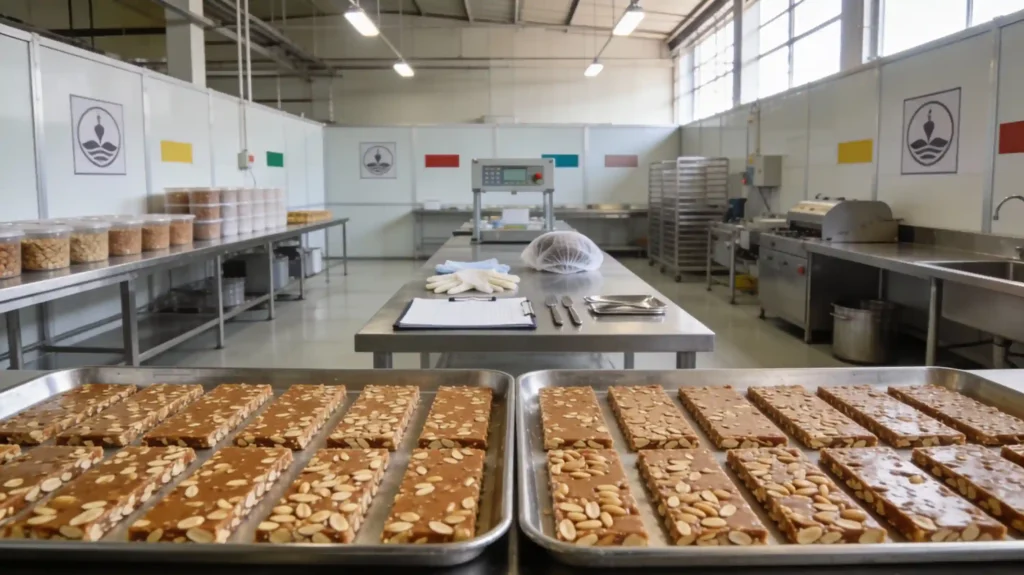
Well-managed chikki units follow practices such as:
- Stainless steel food-contact surfaces
- Regular cleaning schedules for tables and equipment
- Restricted access to production areas
- Use of protective clothing and hand hygiene
These practices reduce contamination risk and ensure consistent output, especially for repeated or bulk orders.
Process Control as a Quality Safeguard
This blog does not focus on step-by-step preparation, but on how quality is protected during production. For readers who want a broader understanding of how the chikki manufacturing process works inside organised units, we’ve explained the complete flow — from raw ingredient handling to controlled production – in our detailed manufacturing guide.
Key control areas include:
- Temperature monitoring during roasting and jaggery cooking
- Timing control to prevent overcooking or premature cooling
- Batch-size management to maintain uniform handling
Example insight:
Jaggery binding stability typically occurs around 118–122°C. Outside this range, texture and shelf stability can be affected.
Understanding FSSAI Compliance in Chikki Manufacturing
FSSAI compliance is often misunderstood as paperwork alone. In reality, it reflects a manufacturer’s responsibility toward food safety.
For chikki manufacturing units, compliance generally involves:
- Documented hygiene and handling practices
- Traceability of raw materials
- Clean production environments
- Regular internal checks
FSSAI compliance does not change tradition – it protects it by ensuring food is safe and responsibly prepared.
Quality Checks Before Packing and Dispatch
Before chikki reaches storage or transport, responsible units carry out final checks.
| Quality Check Area | Purpose |
|---|---|
| Visual uniformity | Indicates proper binding |
| Texture firmness | Prevents breakage |
| Cooling completion | Avoids moisture condensation |
| Packaging integrity | Protects during storage |
These checks are especially important for bulk supply, where consistency across cartons matters.
Storage, Handling, and Transport Hygiene
Quality control does not end at production.
Good manufacturing units ensure:
- Chikki is stored away from heat and humidity
- Packing is done only after full cooling
- Transport conditions prevent moisture exposure
Jaggery-based products are sensitive by nature. Clean handling after production is critical for shelf stability.
Expert Insight: Why Experience Still Matters
Machines can control temperature, but experience controls judgment.
Experienced supervision helps identify:
- Subtle changes in jaggery behavior
- Texture variations across batches
- Early signs of handling issues
This balance of traditional understanding and structured control is what separates consistent output from unpredictable results—whether producing best peanut chikki or sesame chikki.
Responsible Manufacturing at RudrasFoods
At RudrasFoods, the focus is on disciplined manufacturing rather than shortcuts. Quality systems, hygiene practices, and compliance awareness guide daily operations to ensure dependable output for both individual and bulk requirements.
The emphasis remains on responsibility – toward ingredients, process, and the people who consume the product.
How to Identify a Trustable Chikki Manufacturer
When choosing a chikki manufacturer, look beyond appearance and pricing. Responsible units are defined by:
- Hygiene discipline
- Process control
- Compliance awareness
- Consistency across batches
Quality in traditional snacks is not accidental—it is managed.
Closing Note
Chikki may be simple in composition, but producing it responsibly requires structure, care, and accountability. Quality, hygiene, and compliance together ensure that this traditional snack remains safe, consistent, and dependable in a modern food environment.
Looking for a trustable chikki manufacturer?
If quality discipline, hygiene practices, and FSSAI compliance matter to you, RudrasFoods follows a structured manufacturing approach designed for consistent and responsible supply.
You may explore our manufacturing standards and wholesale options to understand how we handle bulk and regular requirements.