Introduction
There’s something magical in that first crack of peanut chikki in India – the brittle snap, the nutty aroma, the caramel warmth. It’s a simple sweet, but behind it lies a long journey of tradition, adaptation, and innovation.
In this article, we’ll trace how peanut chikki went from home kitchens and railway stations to packaged shelves and nutritionally tweaked forms. We’ll also see how it compares with modern snacks like protein bars, and finally, why if you’re looking for a peanut chikki manufacturer, Rudras is a compelling option.
1. The Humble Origins: How Peanut Chikki Began
- The origin story often credits Lonavala, Maharashtra in the 19th / early 20th century. During British Raj, workers building the railway needed a compact energy food. Maganlal Agarwal is said to have created “gud dani” – peanut + jaggery + ghee — to fuel them.
- The sweet became popular among train travellers; Indian Railways later started selling it onboard, turning local recipe into mass snack.
- In folklore, the Marathi word “chikkat” (meaning sticky) is often cited as a root for “chikki.”
- Over time, many regions developed their own names: “kadala mittai” in Tamil Nadu, “palli patti” in Telugu regions, “gud badam” in Bengal.
Thus began the journey – a simple nut + jaggery treat on footpaths, now a flagship Indian sweet.
2. Traditional Recipe & Making Process
To appreciate evolution, let’s first see the classic:
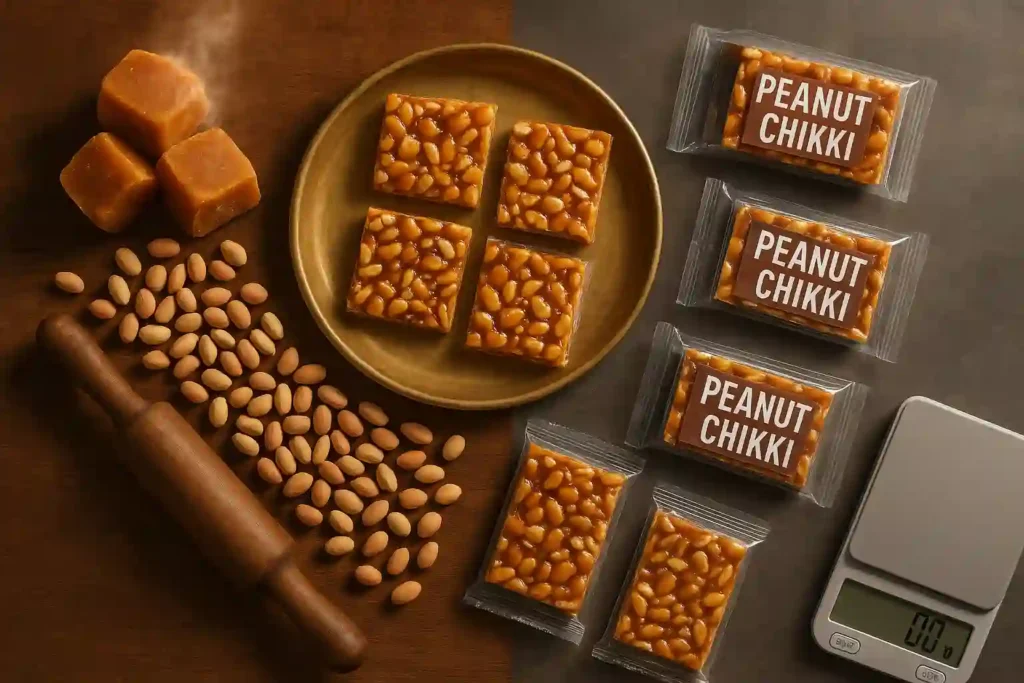
Ingredients (traditional):
- Roasted peanuts (skin removed)
- Jaggery (soft / molten)
- A little ghee (optional)
Process (simplified):
- Roast peanuts until aromatic and skin loosens
- Prepare jaggery syrup to a hard-ball stage
- Mix peanuts into the syrup, coat evenly
- Pour onto a greased or flat surface
- Roll / press to desired thickness (~5–8 mm)
- Cut into shapes (squares, slabs) while warm
- Cool & package
This process is common across many Indian households and small-scale makers.
While the method may look simple, the identity of peanut chikki is shaped by more than just steps and ingredients. Its meaning, traditional purpose, ingredient balance, and everyday usage all contribute to why it has remained relevant across generations — even as preparation methods evolved.
For readers who want a clear, complete understanding of peanut chikki beyond its evolution — including what it is, how it is used today, its nutritional role, and quality factors — we’ve explained this in detail in our guide on what peanut chikki really is, which brings together the basics and modern context in one place.
3. Why Peanut Chikki Has Stood the Test of Time
Nutritional & functional appeal
- Peanuts offer protein, healthy fats, fiber; jaggery adds iron and minerals.
- For instance, Nutra chikki (a variant) was reported to have ~18% protein and increased mineral content compared to control chikki.
- Commercial peanut chikki (like Haldiram’s) delivers ~532 kcal per 100 g, ~16–17 g protein.
- In branded variants, 30 g of Swad in Town peanut chikki gives ~150 kcal (macronutrient mix: fat 46 %, carbs 44 %, protein 10 %)
Thus it isn’t just a sweet – it delivers decent energy in small form.
Cultural resonance & seasonal love
- Chikki is deeply associated with winter and festivals (e.g. Makar Sankranti in many states).
- It’s street-trade friendly (light, nonperishable, compact).
- Regional pride: Lonavala chikki became a brand itself.
4. The Transformation: Modern Innovation
As tastes, market demands, and manufacturing matured, peanut chikki began evolving:
Scaling up & hygiene
- Small kitchen methods gave way to semi-automated or fully mechanized plants to handle consistency, hygiene, shelf life.
- Packaging in vacuum pouches, lamination, moisture barriers became standard to retain crispness.
Nutritional enrichment & variants
- “Nutra chikki” versions added protein isolates, vitamins, minerals to fortify the product.
- Some makers experiment with low-sugar or multi-nut blends (cashews, almonds, sesame) to create gourmet variants
Branding & market strategies
- Chikki isn’t just seasonal anymore; it’s becoming an all-year snack.
- Digital marketing, packaging aesthetics, export ambitions are driving modern trends.
- Many brands now position chikki as an “energy snack” or “healthy indulgence.”
5. Peanut Chikki vs Protein Bars: Can Chikki Be a Fitness Snack?
You want to connect to that “protein / fitness snack” audience. Let’s compare:
| Feature | Peanut Chikki | Typical Protein Bar |
| Protein content | ~10–18% depending on recipe/fortification | Often 20–30+ g per bar |
| Sugar / sweetener | Jaggery / natural sweetener | Often added sugars, syrups |
| Fat / calories | Moderate to high (dense) | Usually controlled, may have saturated fats |
| Ingredient simplicity | Simple (nuts + jaggery), minimal additives | Multiple ingredients, stabilizers, flavorings |
| Processing / packaging | Traditional or semi-mass | Highly processed, engineered for nutrition |
From one blog comparing “Traditional Chikki vs Modern Energy Bars,” they highlight that while chikki is rich in healthy fats and fiber, it may lag in “clean protein ratio” versus bars tailored for fitness markets.
So yes – peanut chikki can be positioned as a “heritage energy bar,” but with clarity:
- It’s more artisanal, natural
- It might have more sugars / fats per gram
- But many health enthusiasts love it for nostalgia + nutrients
You can naturally link from your blog:
“Want a deeper dive? Check our blog How to make peanut chikki at home or Peanut chikki vs protein bar to see how tradition meets fitness trends.”
7. Why Rudras Is a Smart Choice (Soft CTA)
If you are looking for a trusted peanut chikki factory in India, Rudras stands out. Here’s why:
- Focus on quality sourcing – premium peanuts, pure jaggery
- Hygienic processing & modern packaging
- Multiple variants (classic, nutra, gourmet)
- Reliable supply chain across states
If you want a sample, bulk inquiry, or co-branded variant, Rudrasfoods is your go-to partner in peanut chikki.
Also, we use peanut chikki manufacturer lodging exactly once above in a natural way – not forced.
9. Conclusion & Takeaway
Peanut chikki in India is more than a sweet – it’s a story of ingenuity, culture, and adaptation. From the rail tracks of Lonavala to contemporary snack aisles, its journey reflects how traditions can evolve without losing soul.
If you’re craving that authentic crunch, or looking for a partner in peanut chikki manufacturing, Rudrasfoods is here for you.