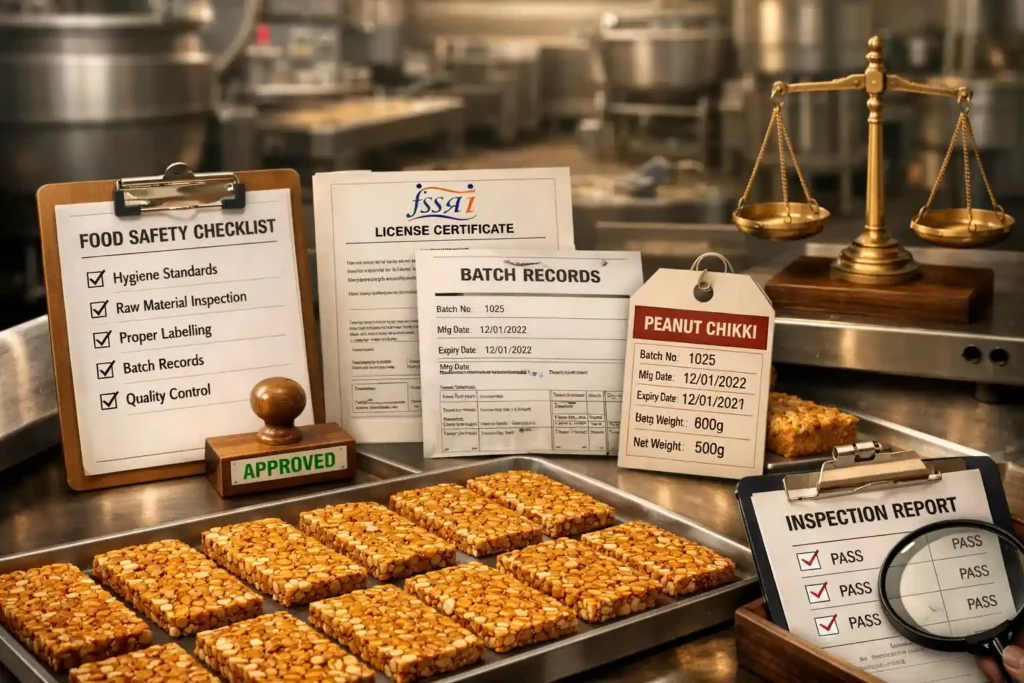
Chikki is one of India’s most trusted traditional snacks, but from a regulatory perspective, it is not treated as a “simple sweet.” Because it involves peanuts (a major allergen), jaggery (moisture-sensitive), heat processing, and manual handling, chikki manufacturing falls under strict food safety rules.
These rules are not written to burden manufacturers. They exist because even a small mistake in sourcing, processing, or storage can turn a safe product into a health risk. Understanding these regulations clearly rather than just memorizing them—is what separates a compliant factory from a risky one.
Food Safety and Standards Act, 2006 – The Foundation of All Rules
Every food safety rule in India begins with the Food Safety and Standards Act, 2006. This Act defines food safety as a legal responsibility, not a moral choice.
Under this law, the Food Safety and Standards Authority of India (FSSAI) was formed to regulate how food is manufactured, stored, transported, and sold.
The focus of this Act is simple but powerful:
anyone who manufactures food is fully responsible for its safety until it reaches the consumer.
For a chikki manufacturing unit, this means that safety is not limited to taste or freshness. It includes ingredient safety, contamination control, labeling accuracy, and traceability.
FSSAI Licensing Rules – Why Manufacturing Without Approval Is Illegal
One of the first and most important requirements under food safety rules is mandatory licensing.
The law clearly states that no food manufacturing activity can operate without an FSSAI license. This rule exists so authorities know who is producing food, where it is produced, and under what conditions.
For chikki units, licensing ensures:
- The factory location is registered
- The type of product manufactured is declared
- The unit is subject to inspection and verification
The core focus of this rule is accountability.
If a problem occurs, the manufacturer cannot disappear or deny responsibility.
Raw Material Regulations – Why Peanuts and Jaggery Are Closely Watched
Food safety rules pay special attention to raw materials, especially in traditional snacks.
Peanuts are legally classified as high-risk ingredients because they are prone to aflatoxin contamination. Aflatoxin is invisible, tasteless, and extremely dangerous if consumed over time. Because of this risk, regulations require manufacturers to use safe, food-grade peanuts sourced from reliable suppliers.
Jaggery, though natural, also attracts moisture and impurities if poorly handled. That is why food safety regulations insist that jaggery used in manufacturing must be clean, uncontaminated, and suitable for food processing.
The focus here is prevention at the source.
Once contaminated raw material enters production, no amount of hygiene can fully fix the problem.
Manufacturing & Processing Rules – What the Law Expects Inside the Factory
Manufacturing-related food safety rules are detailed under Schedule 4 of FSSAI regulations. These rules do not describe how tasty chikki should be. They describe how risk must be controlled.
In simple terms, these rules expect:
- Food-contact surfaces to be safe and non-toxic
- Clear separation between raw materials and finished chikki
- Controlled heating and cooling during preparation
- Limited and supervised access to production areas
The focus of these rules is control, not perfection.
Authorities understand that chikki manufacturing involves manual skill, but they expect systems that prevent avoidable contamination.
Storage and Shelf-Life Rules – Why Finished Chikki Needs Protection
Food safety rules do not end when chikki is prepared. Storage and shelf-life regulations exist because post-production spoilage is one of the most common food safety failures.
Chikki absorbs moisture easily. Even well-made chikki can become unsafe if stored incorrectly. That is why regulations require manufacturers to:
- Store finished products in dry, protected conditions
- Follow FIFO (First In, First Out) stock movement
- Declare realistic “best before” dates based on actual product stability
The core focus of these rules is honesty and protection, not extended shelf life for sales convenience.
Packaging and Labeling Rules – Why Information Is a Safety Tool
Many people think labels are only for branding. In food safety law, labels are treated as consumer safety tools.
Under labeling regulations, every chikki packet must clearly communicate:
- What ingredients are used
- The presence of peanuts as an allergen
- Batch number and manufacturing date
- Best-before period
- FSSAI license number
This rule exists because food safety is not only about manufacturing, it is also about informed consumption. For someone with a peanut allergy, a missing declaration is not a small mistake; it is a serious risk.
Record-Keeping and Traceability – Why Proof Matters More Than Claims
Food safety rules repeatedly emphasize one thing: if you cannot prove it, it did not happen.
Manufacturers are required to maintain records of:
- Raw material intake
- Production batches
- Storage and dispatch
- Complaints and corrective actions
The purpose of these records is not paperwork. It is traceability. If an issue is identified, authorities must be able to trace the affected batch quickly and prevent wider harm.
Food Safety Audits – Why Inspections Focus on Systems, Not Stories
Food safety audits are legal verification exercises. Inspectors do not rely on verbal explanations or intent. They examine:
- License validity
- Record consistency
- Storage and labeling accuracy
- Corrective actions taken after previous observations
The focus of audits is system reliability.
A clean floor alone does not prove food safety. Systems do.
Penalties and Legal Consequences – Why Compliance Protects the Business
When food safety rules are ignored, the law allows authorities to:
- Impose financial penalties
- Suspend or cancel licenses
- Order product recalls
- Initiate legal proceedings in serious cases
For food businesses, the real damage often comes later—loss of buyer trust and market credibility.
That is why experienced chikki manufacturers in india treat food safety rules as a business foundation, not a regulatory formality.
Choosing a Manufacturer That Respects Food Safety Rules
For buyers, wholesalers, and distributors, regulatory discipline matters as much as taste. Working with a manufacturer that understands and respects food safety rules reduces long-term risk.
If you are looking for a chikki factory that follows structured food safety systems, regulatory requirements, and compliance discipline, RudrasFoods operates with a strong focus on responsible manufacturing and regulatory adherence.
👉 Explore RudrasFoods today and partner with a manufacturer that values both tradition and food safety.
References & Regulatory Source
This article is written based on food safety laws, regulations, and compliance guidelines issued by the Government of India through the Food Safety and Standards Authority of India (FSSAI). These regulations define the legal responsibilities, manufacturing requirements, labeling rules, and inspection standards applicable to chikki and snack manufacturing units.
Official reference:
https://www.fssai.gov.in
Disclaimer
Regulatory requirements may change from time to time. Manufacturers are advised to refer to official FSSAI notifications or consult food safety professionals for the latest updates.
Related Manufacturing Blogs
To explore chikki manufacturing in more detail, you may also find these guides useful:
- Raw Material Sourcing in Food Manufacturing: A Complete 360° Guide for Quality, Cost & Consistency
- How to Choose a Trusted Chikki Brand for Wholesale & Individual Orders
- Quality, Hygiene, and FSSAI Compliance in Chikki Manufacturing Units
- How the Chikki Manufacturing Process Works: A Step-by-Step Industry Guide