In Tamil Nadu, some foods quietly cross a line. They stop being something you eat and become something you remember. They settle into childhood, travel, festivals, family jokes, and small habits that repeat without thought. You don’t realise when it happens-until one day you taste it again and feel older than the sweet itself.
Kadalai mittai is one such food.
It was never designed in factories or pushed through advertising. It grew from land that produced peanuts, from jaggery that melted slowly, and from people who learned to stretch very little into enough. This is not the story of one town alone. It is the Tamil Nadu story of kadalai mittai—how a simple peanut sweet moved from village festivals to bus stands, from school pockets to wedding humour, and from oral memory into protected identity.
Before It Had a Market Name
Before kadalai mittai became something that could be weighed, wrapped, or sold, it existed as a practice. Across villages in southern Tamil Nadu—especially in the regions of Thoothukudi, Virudhunagar, and Madurai-elders recall a time when peanuts and jaggery met only during special occasions. Pongal, temple festivals, and oor vizha were the moments when families cooked together and shared food without measurement.
In those days, peanuts were roasted at home and mixed with melted panai vellam (palm jaggery). The mixture was shaped into loose balls and eaten fresh the same day. These sweets were not meant to last or travel. They belonged to community kitchens, harvest rituals, and collective labour. No one thought of selling them.
Paatis still explain this knowledge simply:
“Vellam correct-a oothinaala thaan, innum 50 varusham poidathu.”
Only if the syrup is right, the taste lasts for years.
It is not a recipe. It is experience speaking.
When Necessity Changed the Shape (1940s)
The shift from ritual food to everyday snack began in the 1940s, in Kovilpatti. Post-independence rural Tamil Nadu was defined by caution. Nothing was wasted. Grocers dealt with leftovers, rationing, and unpredictable supply, and innovation often meant survival rather than ambition.
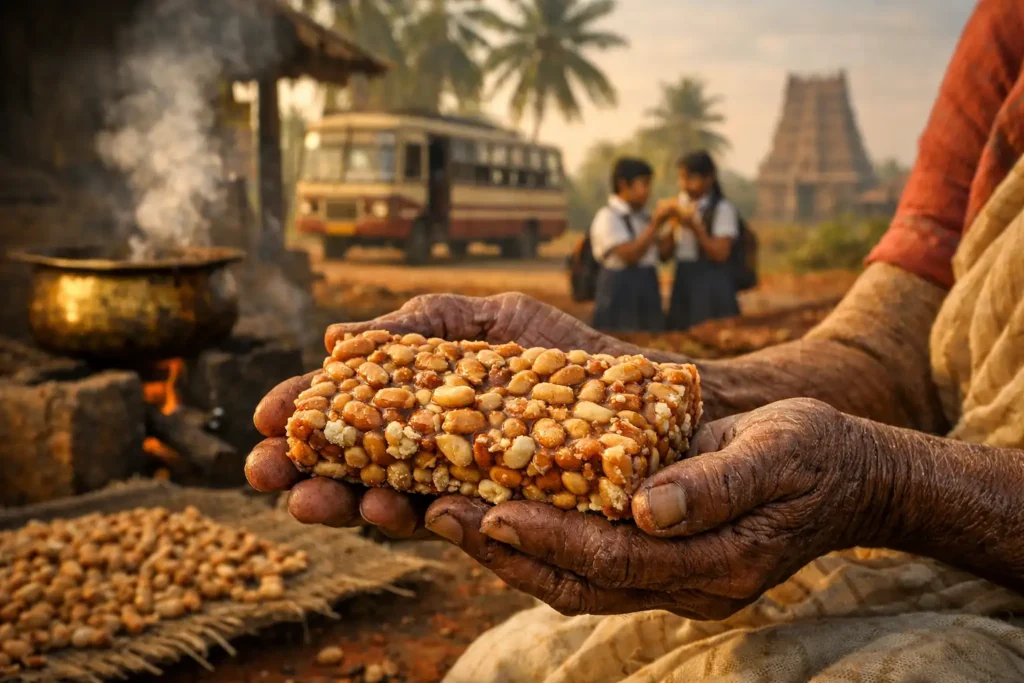
Oral histories across families repeatedly return to one name-Ponnambala Nadar, a small grocery shop owner in the Kovilpatti bazaar. Faced with excess peanuts and jaggery, he chose not to discard them. Instead, he boiled sugarcane jaggery sourced from Theni with local water, mixed in roasted peanuts, and flattened the mixture into rectangular slabs rather than rolling it into balls.
The change was practical. Rectangles stacked better, travelled better, and sold faster. What began as a solution to waste slowly turned into a repeatable form that could move beyond festivals and into everyday life.
As elders still recount with quiet pride:
“Avaru kadalai mittai-ya bazaar-la vechathunaala, bus-la ellam poiduchchu!”
Once he put it in the market, it spread everywhere by bus.
Why Tamil Nadu Called It “Kadalai Mittai”
Tamil food names rarely decorate themselves. They describe what is inside. Kadalai means groundnut. Mittai means sweet. Together, they tell the whole story.
Unlike the Hindi-derived word “chikki” used in other parts of India, Tamil Nadu kept its own naming logic ingredient first, no embellishment. This follows the same pattern as murukku, adhirasam, and vellam. The language reflects an agrarian culture that values recognition over poetry.
When elders say:
“Oru kadalai vaangi vaanga.”
Buy some peanut sweet.
Everyone knows exactly what will arrive.
Land That Made the Sweet Possible
Kadalai mittai could not have emerged everywhere. It needed very specific conditions. Southern Tamil Nadu’s black karisal soils, found in areas such as Kovilpatti, Ottapidaram, Sathankulam, Vilathikulam, and Aruppukottai, produced groundnuts with high oil content and natural sweetness. These peanuts roasted evenly and held their crunch.
Jaggery came from different regions—Theni, Salem, Erode, Madurai clusters like Alanganallur, and the Cauvery delta. It melted slowly, bound well, and worked without refined sugar. Locals still insist that water drawn from the Thamirabarani basin behaves differently during boiling. Whether science confirms it or not, makers swear by the result.
Here, taste is geography speaking.
From Villages to Streets and Bus Stands
Once kadalai mittai took its slab form, it entered public life. Weekly sandhai markets, temple streets, school gates, and bus stands became its natural habitat. It sold cheaply and fed many. Women shelled peanuts at home. Children ran errands. Vendors called out familiar phrases that still echo in memory.
“Kadalai! Taazh kadalai!”
Peanut sweet! Fresh peanut sweet!
By the 1960s and 70s, kadalai mittai had become a school-tiffin staple. One piece could last an entire morning. Thaathas still boast about those days:
“Oru paisa kadalai mittai vaangi, school mudichu varai saapiduven.”
One paisa candy lasted till school ended.
It was food designed for scarcity, not indulgence.
Kovilpatti and Regional Identity
(For deeper detail, see: “Kovilpatti Kadalai Mittai: The Story Behind Tamil Nadu’s Iconic Sweet”)
As production concentrated, Kovilpatti became closely associated with kadalai mittai not by claiming peanuts or jaggery as its own, but through discipline of method. Firewood stoves, careful syrup timing, slab cutting, and consistency built trust over decades. By the late twentieth century, hundreds of small units supported thousands of livelihoods, leading to GI recognition in 2020.
That recognition protects a regional expression, not the entire idea of kadalai mittai. Across Tamil Nadu, the sweet continued to live in homes and small shops, shaped by local habits.
Variations Across Tamil Nadu
Outside Kovilpatti, kadalai mittai adapted quietly. Some regions preferred thicker balls or squares. Some continued using palm jaggery. Northern pockets referred to it as “mallattai.” Quality was judged instinctively, not technically.
Failed batches were mocked as:
“Thanni kadalai.”
Watery peanuts.
Good ones earned praise:
“Kara mittai.”
That sharp crunch.
The name stayed the same. The expression shifted.
Family Jokes, Weddings, and Sweet Closures
In joint families, kadalai mittai became more than a snack it became a metaphor. When the youngest sibling married, families joked that the era of weddings was over.
“Ini ellam kadalai mittai mudiyum, kalyanam over!”
Now only peanut candy left, weddings done.
They called it “kadalai mittai kalyanam.” A joke born from scarcity, softened by sweetness, passed down with laughter.
Skill, Craft, and the “Unbreakable Crunch”
Among maker families, learning took time. Apprentices spent months understanding syrup behaviour and mixing rhythm. Elders speak of clockwise and anticlockwise stirring, of bubbles chased away by instinct rather than thermometers.
One popular tale claims a slab once fell from a moving bus and did not shatter.
“Intha karam illana, Ponnambala avaru sirippaaru!”
If there’s no crunch, Ponnambala will laugh.
Exaggeration perhaps—but the respect for skill is real.
From Open Sales to Modern Tamil Nadu
From the 1980s onward, hygiene standards, packaging, postal delivery, and online orders reshaped consumption. What was once an impulse buy became a gifting item. Urban centres like Chennai and Madurai rediscovered kadalai mittai through nostalgia, while bulk demand grew steadily.
Today, many operations function as a kadalai mittai company across Tamil Nadu-some small, some organised—following the same foundation of peanuts, jaggery, and patience.
Why It Still Endures
Kadalai mittai survived because it never tried to become something else. It stayed simple when trends changed. It fed people when times were hard. It travelled without losing its identity.
Even now, whether purchased for home, gifting, or kadalai mittai wholesale in Tamil Nadu, the sweet carries the same promise. For Tamil Nadu–based manufacturers like RudrasFoods, being a kadalai mittai manufacturer is not about claiming origin, but about respecting the method, preserving taste, and carrying the tradition forward with care.
A Sweet That Remembers Us
Kadalai mittai does not announce its history. It waits in bus stands, in school memories, in a paati’s warning about syrup. And one bite later, you remember why it lasted.
You May Also Like
- What Is Peanut Chikki? Meaning, Making, Benefits & Why It Still Matters Today
An introductory guide explaining what peanut chikki is, how it is traditionally made, and why it continues to remain relevant as a simple, nourishing snack across generations. - From Tradition to Innovation: The Evolution of Peanut Chikki in India
A deeper look into how peanut chikki has evolved over time in different regions of India, adapting to modern production while preserving its traditional foundation. - Nutrients in Peanuts: Calories, Nutrition Facts & Health Value Explained
A detailed breakdown of peanut nutrition, explaining the calories, protein, healthy fats, and minerals that make peanut-based traditional sweets both filling and dependable.