In Tamil Nadu, some foods become more than food. They become identity.
People often say,
“Kovilpattikku kadalai mittai, Chennaiyukku idli!”
It means this sweet belongs to Kovilpatti the way idli belongs to Chennai.
Not because of branding or advertising – but because generations quietly accepted it that way.
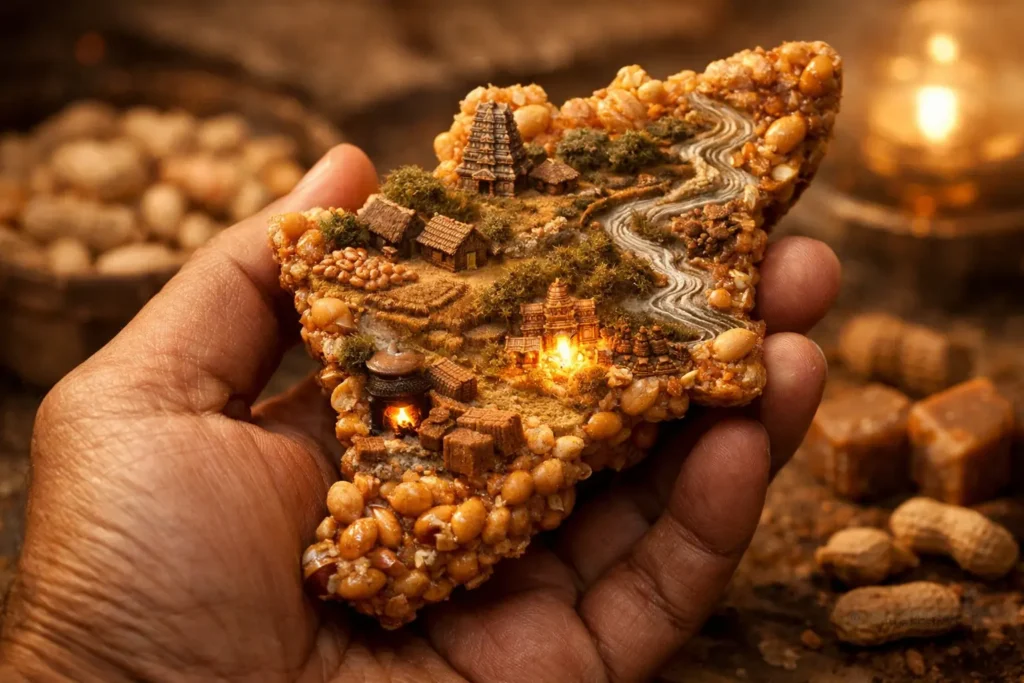
Kovilpatti kadalai mittai is not just a peanut sweet. It is a food shaped by land, climate, people, and habit – made, sold, shared, and remembered for more than a century.
1️⃣ What Is Kovilpatti Kadalai Mittai?
Kovilpatti kadalai mittai is a traditional sweet made using roasted groundnuts (கடலை) and jaggery (வெல்லம்), closely associated with the town of Kovilpatti.
At first glance, outsiders may mistake it for peanut chikki. But locals never do.
The difference is not only in taste, but in feel.
People describe it with a smile:
“Oru mittai saptiya? Aaru aambalaipol sirippa!”
One bite, and you’ll grin like a mango thief.
That sharp crunch followed by warm jaggery sweetness is what makes it instantly recognisable – and unforgettable.
2️⃣ History of Kovilpatti Kadalai Mittai
Before the 1940s: A Festival Sweet
More than a hundred years ago, kadalai mittai was not a product.
It was a practice.
In villages around Kovilpatti, people prepared it during Pongal, temple festivals, and local gatherings. Palm jaggery (karupatti) from local palms and peanuts grown nearby were boiled together and shaped into small balls. These were easy to distribute and meant for sharing.
The sweet belonged to harvest rituals, community kitchens, and collective labour – not commerce.
The 1940s Shift: Necessity Changed the Form
Local histories often associate a major turning point with Ponnambala Nadar, a grocery trader in Kovilpatti during the 1940s.
This was not innovation for scale, but adaptation to reality.
Palm jaggery became harder to source. Sugarcane jaggery from Theni and Salem was more readily available. Round shapes were difficult to stack, store, and transport.
Out of practicality:
- Palm jaggery gave way to sugarcane jaggery
- Shapes shifted from balls to rectangular slabs
- Cutting allowed better shelf life and easier sale
Sold cheaply in grocery shops, bus stands, and theatres, the sweet slowly moved from festival-only food to everyday snack.
Growth Into an Industry (1950s–2000s)
Workers trained in early shops began setting up their own units. Families handled roasting, mixing, cutting, and packing together.
Over the decades:
- More than 120 small and mid-sized units emerged
- Employment crossed 20,000 people, many of them women
- Production scaled up, especially during festivals
Unlike ghee-heavy chikkis found elsewhere in India, this mittai stayed dry, light, and travel-friendly – ideal for Tamil Nadu’s climate.
🔹 Key Milestones in the Journey of Kovilpatti Kadalai Mittai
| Era | What Happened | Why It Mattered |
|---|---|---|
| Pre-1940s | Festival sweets made with palm jaggery | Ritual and community food |
| 1940s | Ponnambala Nadar adopts sugarcane jaggery and slab cutting | Beginning of commercial sale |
| 1950s+ | Factory growth with 120+ units | Employment for 20,000+ people |
| 2014–2020 | GI application and approval | Legal identity and protection |
| 2026 | ~40% price rise | Highlighted raw material dependency |
3️⃣ Ingredients Used in Authentic Kovilpatti Kadalai Mittai
The strength of this sweet lies in how little goes into it – and how carefully each part is handled.
Groundnuts are sourced from black-soil regions around Kovilpatti, Aruppukottai, and Kazhugumalai. These peanuts have higher oil content, which contributes to flavour and crunch.
Jaggery is traditionally sugarcane-based, sourced from belts like Theni and Salem. It is pale, slow-melting, and very different from refined sugar.
Water also matters. Locals often speak about the influence of Thamirabarani River and surrounding water sources on jaggery behaviour during boiling.
There are no preservatives, no artificial binders, and no flavour masking – which is why kadalai mittai ingredients remain a frequent topic of discussion even today.
4️⃣ Traditional Preparation Method
In Kovilpatti, people often say:
“Veragu aduppu, Thamirabarani neeru – mittai rusi thevai!”
Firewood stove and river water – that’s where the taste comes from.
Traditionally, peanuts are roasted until evenly crunchy. Jaggery is heated slowly until it reaches the correct binding stage. Both are mixed by hand, poured onto wooden or metal sheets, flattened, and cut while still warm.
Some units lightly dust the surface with poolankizangu powder, believed to support digestion.
Timing matters more than machines.
5️⃣ Why Kovilpatti Kadalai Mittai Tastes Different
The taste is shaped by many small factors working together.
The dry climate allows controlled roasting. The peanuts themselves carry flavour. Jaggery caramelises without bitterness when handled patiently. Most importantly, makers rely on experience – not thermometers.
There is no ghee heaviness. No stickiness.
Just a clean snap and lingering nutty sweetness.
6️⃣ Health and Cultural Role
Traditionally, kadalai mittai was never treated as a dessert.
It was an energy snack for workers, a school-time treat for children, a travel companion on long bus journeys, and a steady tea-time sweet in many homes.
Peanuts provide protein and healthy fats. Jaggery contributes iron and minerals. This balance is why elders trusted it without question.
7️⃣ Is All Kovilpatti Kadalai Mittai the Same Today?
Not always.
Differences appear when:
- Sugar replaces jaggery
- Fully automated processes skip timing judgment
- Overheating hardens the sweet
Locals still test quality instinctively – by sound, aroma, and texture. Plain versions remain more trusted than heavily topped ones.
8️⃣ Buying Habits, Packaging, and Seasonal Demand
People buy kadalai mittai in many ways.
Daily impulse purchases from roadside stalls. Theatre snacks before films. Elders stocking for evening tea. Tourists carrying 250-gram and 1-kilogram packs home.
People joke,
“Paisa okkantum, mittai vaangita po!”
Forget the price – just buy the mittai.
Packaging has evolved from butter paper twists to sealed pouches, boxes, and export-ready vacuum packs.
Demand peaks during Deepavali and Pongal, stays steady through monsoon travel seasons, and dips slightly in summer before rising again during school holidays.
It remains a year-round staple.
9️⃣GI Recognition: Protecting a Regional Identity (2014–2020)
As the sweet travelled beyond Kovilpatti, imitation followed.
To protect its identity, the manufacturers’ association applied for Geographical Indication (GI) status in 2014.
After years of verification, the GI tag was granted in April 2020.
It protects:
- Native peanuts from the Kovilpatti belt
- Use of organic jaggery
- Traditional boiling, rolling, and cutting methods
With this, kovilpatti kadalai mittai joined Tamil Nadu’s protected foods such as Srivilliputtur Palkova.
🔟Recent Market Context
In early 2026, groundnut prices rose sharply, pushing wholesale prices up by nearly 40%. Many buyers shifted to smaller packs, but demand remained steady – showing how deeply rooted this sweet is in daily life.
1️⃣1️⃣How This Tradition Inspires Modern Makers
Kovilpatti kadalai mittai did not become famous through marketing.
It earned its place through consistency, restraint, and respect for ingredients.
That philosophy continues to inspire producers across the state. Many today operate as a kadalai mittai manufacturer in Tamil Nadu, following the same foundation – peanuts, jaggery, patience – even outside Kovilpatti.
Brands like Rudrasfoods draw inspiration from this legacy, adapting traditional principles to modern hygiene, wider distribution, and wholesale needs – without claiming the origin.
Respecting the method.
Not copying the name.
Why This Sweet Endures
Kovilpatti kadalai mittai has survived generations, shortages, price changes, and trends because it stayed close to people and land.
And even today, one bite still makes people smile.
Related Blogs
What Is Peanut Chikki? Meaning, Making, Benefits & Why It Still Matters Today
Top Peanut Chikki Benefits That Make It More Than Just a Sweet
Nutrients in Peanuts: Calories, Nutrition Facts & Health Value Explained