There is a quiet, powerful truth that every food connoisseur realizes only after tasting the traditional sweets of Tenkasi. You don’t notice it the moment the Kadalai Mittai (Peanut Chikki) snaps between your teeth. You notice it a few seconds later—a clean, lingering sweetness that feels “complete” rather than just sugary. It is a flavor that feels rooted in the earth itself.
From the legendary Tirunelveli Halwa to the artisanal peanut and sesame chikkis of the region, one question haunts every food lover: Why does the taste change the moment you leave the banks of the Thamirabarani?
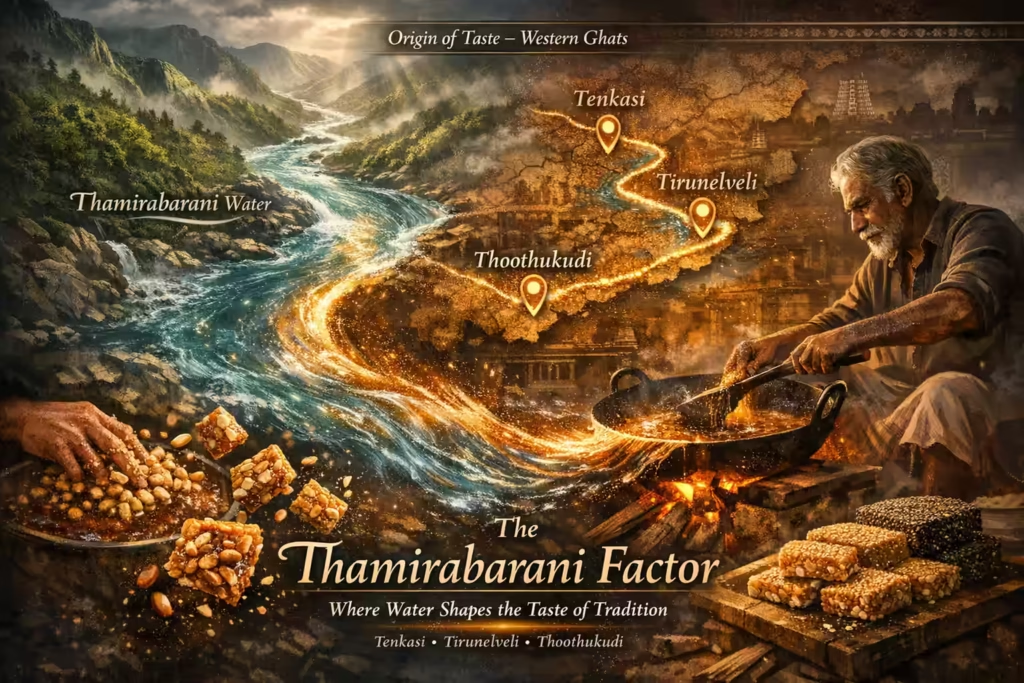
The answer is not found in a secret recipe book or a hidden additive. It is found in the very molecules of the water used in production. This is the story of the “Thamirabarani Factor”—the scientific and cultural foundation of why Tenkasi sweets possess a unique flavor profile that no industrial machine can ever replicate.
The Hydro-Chemistry of the “Copper River”
The Thamirabarani is South India’s only perennial river, but its secret lies in its birthplace: the Agasthyamalai hills of the Western Ghats. This region is home to over 2,000 species of medicinal plants. As the water flows over these herbs and specific quartz-rich rock formations, it undergoes a natural ionization process.
In the industry, we call this “The Copper Effect.” Historically, the river was named for its high copper content (Thamiram means copper), which acts as a natural purifier. But for a chikki manufacturer from Tenkasi, this water is a functional ingredient.
The “Perfect Water” Profile for Confectionery
To understand the topical authority of Tenkasi sweets, we must look at the laboratory-grade data of this water:
| Property | Value | Impact on Sweet & Chikki Production |
| pH Level | ~7.5 (Slightly Alkaline) | Neutralizes the sharp acidity of raw jaggery, creating a “rounder” sweetness. |
| Water Hardness | Low (~56 mg/L) | Ensures the jaggery syrup remains clear and smooth, preventing “grainy” crystallization. |
| Natural Minerals | Copper & Magnesium | Acts as a catalyst for the Maillard reaction, intensifying the nutty aroma of roasted peanuts. |
| Total Dissolved Solids (TDS) | ~190 mg/L | Provides a “clean” canvas that allows the native peanut oils to shine without interference. |
The Science of the “Jaggery-Water Synergy”
Making a perfect Peanut Chikki or Ellu Mittai (Sesame Chikki) is an exercise in thermodynamics. When a maker dissolves jaggery in Thamirabarani water, the low mineral interference allows the jaggery to reach its “Critical Boiling Point” more predictably.
The Stages of the “Hard Crack”
In traditional manufacturing, we look for the Hard Crack Stage (approx. 145°C to 150°C).
- With RO Water: The water is “too pure,” often leading to a brittle, glass-like texture that lacks flavor depth.
- With Hard Borewell Water: The minerals interfere with the sugar bonds, causing the chikki to become “sticky” or “chewy,” sticking to the teeth.
- With Thamirabarani Water: The alkalinity of the water allows the jaggery to caramelize slowly. This produces that signature “Snap”—a clean break that dissolves beautifully on the tongue.
Technical Insight: This chemistry is why a Tenkasi chikki maker can achieve a 4-month shelf life without using a single artificial preservative. The water-jaggery bond is naturally stable.
A Regional Sensory Signature
The impact of this water isn’t just theoretical; it defines the three pillars of the South Tamil Nadu snack identity:
- Tirunelveli Halwa: The wheat-milk fermentation process is highly sensitive to water pH. Thamirabarani water ensures the halwa retains its “slip”—that glossy, jelly-like texture that melts the moment it hits the heat of your mouth.
- Kadalai Mittai (Peanut Chikki): The water ensures the jaggery coating is paper-thin and crystal clear. You see the peanut, you taste the crunch, and the sweetness acts only as a supporting actor.
- Ellu Mittai (Sesame Chikki): Sesame has a natural bitterness. The minerals in the river water bridge the gap between the bitter oils of the seed and the sweet caramel of the jaggery, creating a balanced, savory-sweet profile.
Beyond Taste: The Nutritional Logic of Tradition
In an era of “junk food,” the traditional Tenkasi sweet stands out as a functional health snack. This is a section most modern blogs miss, but it is vital for your readers.
1. The Glycemic Advantage
By using unrefined jaggery processed with mineral-rich water, the body absorbs the sugar more slowly compared to white-sugar-based candies. This prevents the “sugar crash” associated with modern confectionery.
2. High Protein & Essential Fats
The peanuts used in our region are grown in black soil, which is naturally rich in nitrogen. This results in peanuts with a higher oil content (monounsaturated fats) and protein density. When paired with jaggery—which is a powerhouse of Iron and Potassium—the Kadalai Mittai becomes a perfect “energy bar” for children and athletes.
The Trinity of Flavor: Water, Fire, and Soil
While the river provides the soul, the Tenkasi sweets unique taste is completed by two other factors:
- The Wood-Fire (Viragu Aduppu): Industrial gas burners provide “angry,” aggressive heat. In contrast, wood-fired stoves provide a gentle, radiant heat. This allows the jaggery to develop smoky undertones that complement the roasted aroma of the nuts. (Learn more in our guide on how wood stoves change the taste of chikki).
- The Kovilpatti Connection: The neighboring town of Kovilpatti achieved a GI (Geographical Indication) Tag specifically because the government recognized that the combination of native peanuts and local water creates a product that cannot be made elsewhere. (Read the History of Kovilpatti Kadalai Mittai).
A Consumer’s Guide: How to Identify & Preserve Authentic Chikki
To provide the most value to our readers, we have compiled this checklist to ensure you are getting the real “Thamirabarani Experience.”
How to Spot the Real Deal
- The “Snap” Test: Authentic chikki should break with a loud, clean “clink.” If it bends or feels rubbery, it was likely made with high-moisture industrial syrup.
- The Color Check: It should be a deep, transparent amber. If it looks opaque or pale yellow, it may contain bleached sugar.
- The Aroma: Open the pack and smell. You should smell “roasted earth” (from the nuts) and “caramelized wood” (from the wood-fire).
How to Store for Maximum Freshness
To keep your online order of Kadalai Mittai fresh:
- Avoid Humidity: Moisture is the enemy of the “snap.” Store in an airtight glass jar.
- No Refrigeration: Cold air can make the jaggery “sweat” when brought to room temperature, leading to stickiness.
- Room Temperature: Keep it in a dark, cool cupboard to preserve the natural oils in the peanuts.
RudrasFoods: Carrying the Legacy Forward
At RudrasFoods, we don’t just manufacture snacks; we are the custodians of a regional identity. We understand that being a chikki maker from Tenkasi means respecting the river and the traditional wood-fired methods.
In a world of mass production, we choose the slow path. We source our peanuts from local black-soil farmers and ensure our jaggery is processed with the same water that has defined our ancestors’ recipes for generations. When you search for “kadalai mittai online order“ or “sesame chikki online,” you aren’t just buying a snack—you are investing in the preservation of an authentic South Indian legacy.
Conclusion: A Taste That Cannot Be Manufactured
The secret of Tenkasi is not a trade secret; it is a geographical gift. It is in the river, the soil, the fire, and the patient hands of the maker. The tenkasi sweets unique taste is grown and nurtured over centuries.
Once you experience the “Thamirabarani Factor,” you realize that you aren’t just eating a sweet anymore. You are tasting the geography, the science, and the history of Tamil Nadu.
References & Further Reading
- Geographical Indications Registry of India: Kovilpatti Kadalai Mittai, Registered GI Application No. 486 (Certificate Date: 20/04/2020), Class 30.
Official Pdf Link by orgin-gi - Ministry of Jal Shakti (PIB Delhi): Ecological Health Assessment of Thamirabarani River (Published: 04 Dec 2025). This report confirms the BOD and pH stabilization that creates the “unique taste” region.
Official Press Release – PIB Delhi - Sustainability (MDPI Journal): “Hydrogeochemistry and Water Quality Assessment in the Thamirabarani River Stretch by Applying GIS and PCA Techniques” (2022). This study details the specific alkaline pH (7.2-8.1) found in the Tirunelveli/Tenkasi stretches.
Full Research Article – MDPI - Food Chemistry Journal: “Effects of temperature and pH on the kinetics of caramelisation…” (Vol 107, Issue 3). This provides the scientific backing for why alkaline water improves the browning and aroma of jaggery.
Journal Article – ScienceDirect/Food Chemistry - Anthropological Survey of India (AnSI): Traditional Food Systems of India – South Zone. While specific 1940s digital archives are rare, this body of work documents the historical relationship between South Indian rivers and regional confectionery.
General Publications Archive – Anthropological Survey of India